Showing posts with label LTE-Advanced. Show all posts

Thursday, April 9, 2026

3GPP Release 19 Description and Summary of Work Items

As the journey towards 3GPP Release 20 and 6G (3GPP Rel-21) continues to gather pace, the recently concluded Release 19 comes with a clearer view of what the next phase of 5G evolution, often referred to as 5G-Advanced, will look like in practice. One of the most useful artefacts in this process is the recently published technical report 3GPP TR 21.919, which offers a consolidated snapshot of the features and work items currently shaping this release.

Rather than focusing on detailed specifications, this report takes a step back and provides accessible summaries of the agreed work items. Each summary is intended to answer two simple but important questions: what problem is being addressed, and what impact the feature will have on the overall system. This makes the document particularly valuable not only for specialists deeply involved in standardisation work, but also for a broader audience trying to keep track of where the industry is heading.

It is worth noting that this is still very much a work in progress (50% complete). At the time of publication, just over 60 summaries have been included, with many more expected in future updates. Even so, the current version already highlights the sheer breadth of activity in Release 19, spanning everything from energy efficiency and non-terrestrial networks to AI, immersive services, and advanced radio capabilities.

In this post, I will not attempt to reinterpret or condense the summaries themselves. Instead, I am sharing the full list of topics covered in the report below, which provides a useful index into the areas that 3GPP worked on as part of Release 19.

It should be noted that the technical report (TR) presents the "initial state" of the Features introduced in Release 19, i.e. as they are by the time of publication of this document. Each Feature is subject to be later modified or enhanced, over several years, by the means of Change Requests (CRs). To further outline a feature at a given time, it is recommended to retrieve all the CRs which relate to the given Feature, as explained in its Reference section. 

Below is the list of all topics covered in this report. Some of the topics may be missing a summary, which will be added later in the later updates.  

5 Rel-19 Energy Efficiency, Energy Saving
5.1   Enhancements of Network energy savings for NR
5.2   Low-power wake-up signal and receiver for NR (LP-WUS/WUR)
5.3   Energy Efficiency as Service Criteria

6   Rel-19 Satellite (5GSAT), NTN, UAS, Aerial
6.1   Satellite access Phase 3
6.1.1   Security Aspects of 5G Satellite Access Phase 3
6.1.2   Charging aspects of satellite access Phase 3
6.2   Non-Terrestrial Networks (NTN) for NR Phase 3
6.3   Enhancements for Air-to-ground network for NR
6.4   Inter-RAT mode mobility support from E-UTRAN TN to NR NTN
6.5   Non-Terrestrial Networks (NTN) for Internet of Things (IoT) Phase 3 (for LTE)
6.6   Introduction of IoT-NTN TDD mode
6.7   Enhanced requirements and test methodology for NR NTN and IoT NTN
6.8   On-demand broadcast of GNSS assistance data
6.9   Uncrewed Aerial System Phase 3
6.10   Support for PWS in Satellite E-UTRAN and Satellite NG-RAN
6.11   Introduction of BDS (BeiDou Navigation Satellite System) B2b Signal in A-GNSS for LTE and NR
6.12   Introduction of A-GNSS support for NavIC (Navigation with Indian Constellation) L1 SPS (Standard Positioning Service) in NR & LTE
6.13   Management Aspects of Rel-18's NTN Phase 2
6.14   Lower Selection-priority for PLMN Selection
6.15   New LTE band for 5G broadcast for region 3 utilizing a geosynchronous satellite
6.16   Satellite band-related items
6.16.1   Introduction of Ku bands for NR NTN
6.16.2   Introduction of additional operating NR bands for HAPS (High Altitude Platform Station)
6.16.3   Introduction of another NR NTN S-band (MSS band 2000-2020 MHz UL and 2180-2200 MHz DL)
6.16.4   New NR NTN bands to support Extended L-band and combined MSS L-band and Extended L-band ranges
6.16.5   Introduction of another IoT-NTN S-band (MSS band 2000-2020 MHz UL and 2180-2200 MHz DL)

7   Rel-19 Internet of Things (IoT) and Reduced Capability (RedCap) UE
7.1   NR power class 2 RedCap (Reduced Capability) UE in FR1
7.2   NAS layer overhead reduction for data transfer using CP CIoT
7.3   Management Aspects of RedCap features

8   Ambient power-enabled Internet of Things (IoT)
8.1   Ambient power-enabled Internet of Things (IoT) (SA and CT)
8.1.1   Charging for Ambient power-enabled Internet of Things
8.1.2   Security Aspects of Ambient IoT Services in 5G for Isolated Private Networks
8.2   Solutions for Ambient IoT (Internet of Things) in NR

9   Rel-19 Artificial Intelligence (AI)/Machine Learning (ML)
9.1   AI/ML Model Transfer Phase 2
9.2   Core Network Enhanced Support for Artificial Intelligence (AI)/Machine Learning (ML)
9.3   Application enablement for AI/ML services
9.4   Artificial Intelligence (AI)/Machine Learning (ML) for NR air interface
9.5   Artificial Intelligence (AI)/Machine Learning (ML) for NR air interface
9.6   Enhancements for Artificial Intelligence (AI)/Machine Learning (ML) for NG-RAN
9.7   AI/ML Management Phase 2
9.8   Protocol for AI Data Collection from UPF

10   Rel-19 Verticals and Non Public Network
10.1   Rel-19 Enhancements of 3GPP Northbound and Application Layer Interfaces and APIs
10.2   SEAL DD (Data Delivery) Phase 2
10.3   Common Application Programming Interface (API) Framework (CAPIF) Phase 3
10.4   Enhanced OAM for management service exposure to external consumers through CAPIF
10.5   Non-Public Network (NPN) security considerations
10.6   Security for PLMN hosting a NPN
10.7   Interconnect of SNPN
10.8   ProSe support in NPN

11   Rel-19 communications services
11.1   Media Messaging Enhancements
11.2   Terminal Audio quality performance and Test methods for Immersive Audio Services, Phase 2
11.3   EVS Codec Extension for Immersive Voice and Audio Services, Phase 2
11.4   5GMSG Service phase 3
11.5   Video Operating Points - Harmonization and Stereo MV-HEVC
11.6   Advanced Media Delivery
11.7   5G Real-time Transport Protocol Configurations, Phase 2
11.8   Next Generation Real time Communication services Phase 2
11.8.1   System architecture for Next Generation Real time Communication services Phase 2
11.8.2   Security support for the Next Generation Real Time Communication services Phase 2
11.8.3   Application enablement aspects for MMTel

12   Rel-19 XR (eXtended Reality), Augmented Reality (AR), Metaverse, Edge Computing
12.1   Localized Mobile Metaverse Services
12.2   Extended Reality and Media
12.3   XR (eXtended Reality) for NR Phase 3
12.4   Avatar Communications in AR Calls
12.5   Split rendering over IMS
12.6   Enhancement of support for Edge Computing in 5G Core network - Phase 3
12.7   Edge Computing for Industrial Scenarios
12.8   Edge Computing Considering the Operational Needs of Service Hosting Environment
12.9   Architecture for enabling Edge Applications Phase 3

13   Rel-19 High Power UEs (HPUE)
13.1   Rel-19 High power UE (power class 1.5 or 2) for NR intra-band CA or NR inter-band CA/DC band combinations with/without NR Supplementary Uplink (UL)
13.2   Rel-19 High power UE (power class 1.5 and 2) for NR FR1 TDD/FDD single band for handheld/FWA UEs, and high power UE operation (power class 1) for FWVM (fixed-wireless/vehicle-mounted) use cases in a single NR band
13.3   Introduction of Power Class 2 and UE 40MHz Channel Bandwidth in NR band n28
13.4   Rel-19 High power UE (power class 1.5 or 2) for DC combinations of LTE band(s) and NR band(s)
13.5   Rel-19 High power UE (power class 2) and high power operation (power class 1) for fixed-wireless/vehicle-mounted use cases in a single LTE band

14   Rel-19 RAN topology
14.1   5G NR Femto
14.2   Additional topological enhancements for NR
14.3   Vehicle Mounted Relays Phase 2

15   Rel-19 Sidelink, Proximity
15.1   NR sidelink multi-hop relay
15.2   UE-to-UE multi-hop relay
15.3   NR Sidelink: Intra-band Carrier Aggregation in ITS band
15.4   Charging Aspects of Ranging and Sidelink Positioning
15.5   Multi-path relay
15.6   Proximity-based Services in 5GS Phase 3

16   NR and LTE Dual Connectivity (DC)
16.1   UE RF enhancements for NR FR1/FR2 and EN-DC, Phase 4
16.2   Support of intra-band non-collocated EN-DC/NR-CA deployment Phase2: new receiver type(s)
16.3   Rel-19 downlink interruption for NR and EN-DC band combinations at dynamic Tx Switching in Uplink
16.4   Rel-19 DC of x LTE band(s), y NR band(s) (1<=x<6, 1<=y<6, x+y<=6) and single or two NR Supplementary Uplink (SUL) bands
16.5   Simultaneous Rx/Tx band combinations for NR CA/DC, NR SUL and LTE/NR DC in Rel-19
16.6   UE Conformance - Rel-19 NR CA and DC; and NR and LTE DC Configurations

17   Rel-19 Other NR and LTE Radio
17.1   Adding channel bandwidth(s) support to existing NR bands and CA/ENDC combinations in REL-19
17.2   Data collection for SON (Self-Organising Networks)/MDT (Minimization of Drive Tests) in NR standalone and MR-DC (Multi-Radio Dual Connectivity) Phase 4

18   Rel-19 NR Radio
18.1   NR mobility enhancements Phase 4
18.2   Evolution of NR duplex operation: Sub-band full duplex (SBFD)
18.3   NR Radio Resource Management (RRM) Phase 5
18.4   Multi-carrier enhancements for NR Phase 3
18.5   NR demodulation performance Phase 5
18.6   NR MIMO Phase 5
18.7   FR1 TRP, TRS and MIMO OTA testing enhancement Phase 3
18.8   Rel-19 NR CA/DC for x bands DL with y bands UL (x<7, y<3) and SUL/CA band combinations with a single SUL or two SUL cells
18.9   Low band carrier aggregation via switching
18.10  NR channel BW less than 5MHz for FR1 Phase 2
18.11  mmWave in NR: UE spurious emissions and EESS (Earth Exploration Satellite Service) protection
18.12  NR base station (BS) RF requirement evolution for FR1/FR2 and testing
18.13  UE Conformance - New Rel-19 NR licensed bands and extension of existing NR bands
18.14  Other band-related items
18.14.1   7MHz Channel Bandwidth for n26 and n5
18.14.2   Introduction of the NR FDD 1.4 GHz band
18.14.3   Introduction of NR bands n87 and n88
18.14.4   Introduction of NR band n68
18.14.5   Additional NR bands for NR features in Rel-19
18.15  Study on spatial channel model for demodulation performance requirements for NR

19   Rel-19 LTE Radio
19.1   LTE-based 5G Broadcast Phase 2
19.2   Rel-19 LTE-Advanced Carrier Aggregation for x bands (1<=x<= 6) DL with y bands (y=1, 2) UL
19.3   Band-related items
19.3.1   New bands for LTE based 5G terrestrial broadcast for early deployments
19.3.2   Introduction of LTE FDD band in 1800–1830 MHz for Canada

20   Rel-19 Mission Critical, eCall, Emergency
20.1   Enhanced Mission Critical Architecture
20.2   Enhanced Mission Critical Location Management
20.3   Alignment of eCall over IMS with CEN
20.4   UE Conformance - Alignment of eCall over IMS with CEN
20.5   Multiple Location Procedure for Emergency LCS Routing
20.6   Multimedia Priority Service (MPS) for Messaging services
20.7   Mission Critical (MC) services for generic support on Isolated Operation for Public Safety (IOPS) mode of operation
20.8   Sharing of administrative configuration between interconnected MC service systems
20.9   Future Railway Mobile Communication System (FRMCS) Phase 5
20.10   Mission critical security enhancements for release 19
20.11   Protocol enhancements for Mission Critical Services

21   Rel-19 Network Slicing
21.1   Network Controlled Network Slice Selection

22   Rel-19 Service-Based Architecture (SBA)
22.1   UPF enhancement for Exposure And SBA Phase 2
22.2   Automatic Certificate Management Environment (ACME) for the Service Based Architecture (SBA)
22.3   Reducing Information Exposure over SBI
22.4   Service Based Interface Protocol Improvements Release 19

23   Rel-19 QoS and Policy
23.1   Rel-19 Enhancements of UE Policy
23.2   Rel-19 Enhancements of Session Management (SM) Policy
23.3   Minimize the Number of Policy Associations
23.4   Spending Limits for UE Policies in Roaming scenario
23.5   Enhancing Parameter Provisioning with static UE IP address and UP security policy
23.6   Providing per-subscriber VLAN instructions from UDM and DN-AAA
23.7   QoS monitoring enhancement

24   Rel-19 multi-access
24.1   Upper layer traffic steering and switching over dual 3GPP access
24.2   Multi-Access (ATSSS_Ph4)
24.3   ATSSS Rule Provisioning via 3GPP access connected to EPC
24.4   Local traffic routing for multi-access UE

25   Other topics
25.1   Deferred 5GC-MT-LR Procedure for Periodic Location Events based NRPPa Periodic Measurement Reports
25.2   Subscription control for reference time distribution in EPS
25.3   Rel-19 IMS:
25.3.1   PS Data Off for IMS Data Channel Service
25.3.2   IMS Disaster Prevention and Restoration Enhancement
25.3.3   IMS Stage-3 IETF Protocol Alignment
25.4   Identifying non-3GPP Devices Connecting behind a UE or 5G-RG
25.5   Integrated Sensing and Communication
25.6   Rel-19 Application Data Analytics Enablement Service
25.7   Interworking of Non-3GPP Digital Terrestrial Broadcast Networks with 5GS Multicast Broadcast Services
25.8   Minimization of Service Interruption During Core Network Failure Phase 2
25.9   Measurement Data Collection
25.10  Enhanced application layer support for location services
25.11  NF discovery and selection by target PLMN
25.12  MSISDN verification operation support to Nnef_UEId Service
25.13  Rel-19 Enhancements of Network Automation Enablers
25.14  Enhancement of controlling RAT utilization
25.15  CT Aspects for IP Domain usage
25.16  Indirect Network Sharing
25.17  Management of Network Sharing Phase 3
25.18  Roaming Value-Added Services
25.19  Monitoring of signalling traffic in 5G
25.20  Roaming traffic offloading via session breakout in HPLMN
25.21  Stage-3 5GS NAS protocol development 18
25.22  Stage-3 SAE Protocol Development
25.23  Harmonization of test case definitions for cross-RAT usability
25.24  Data management regarding subscriptions and reporting
25.25  PRU Usage Extension supported by Core Network

26   Rel-19 miscellaneous Security
26.1   Security Assurance Specification for maintenance of 5G features
26.2   5G Security Assurance Specification (SCAS) for the Unified Data Repository (UDR)
26.3   5G Security Assurance Specification (SCAS) for the Short Message Service Function (SMSF)
26.4   Addition of 256-bit security Algorithms
26.5   Addition of Milenage-256 algorithm
26.6   Roaming and interconnect authorization aspects in indirect communication
26.7   Public key distribution and Issuer claim verification of the Access Token
26.8   3GPP profiles for cryptographic algorithms and security protocols
26.9   Mobility over non-3GPP access to avoid full primary authentication
26.10  LI Handling of Protected Services
26.11  Lawful Interception Rel-19
26.12  Lawful Interception Guidance Rel-19
26.13  Specification of example algorithm for alternative f5* (f5**) function

27   Rel-19 miscellaneous OAM&charging
27.1   Charging aspects for Multi-Operator Core Network (MOCN) Network Sharing
27.2   Service Based Management Architecture enhancement phase 3
27.3   Management Data Analytics phase 3
27.4   Intent driven management services for mobile network phase 3
27.5   Management of planned configurations
27.6   Management aspects of Network Digital Twins
27.7   Closed Control Loop Management
27.8   Data management phase 2
27.9   5G performance measurements and KPIs phase 4
27.10  5G Advanced NRM features phase 3
27.11  Subscriber and Equipment Trace and QoE collection management
27.12  Management of IAB nodes
27.13  Enhancement of Management Aspects Related of NWDAF Phase 2
27.14  CHF Segmentation
27.15  Subscriber Data Migration

You can download the latest version of the specs from here.

Related Post

Monday, May 6, 2024

6G and Other 3GPP Logos

The Project Coordination Group (PCG) of 3GPP recently approved a new logo for use on specifications for 6G, during their 52nd PCG meeting, hosted by ATIS in Reston, Virginia. As with previous logos, surely people in general will use them not just for 3GPP 6G compliant products, but for all kinds of things.

Over the years many people have reached out to me to ask for 3GPP logos, even though they are available publicly. All 3GPP logos, from 3G to 6G is available in the Marcoms directory here. In addition to the logo, each directory also lists guidance for use of the logos. For example, 3GPP does not allow the use of the logo as shown on the left in the image on top of the post while the one on the right is okay.

Surely there isn't an issue for general use but for anyone wishing to use the logos for their products, equipment, documentation or books, they will have to strictly comply with the rules.

Related Posts

Sunday, October 29, 2017

5G Forecasts and 5G Deployed Claim

Source: GSA

5G forecasts have been arriving steadily with many different figures. Here are some numbers:

Date Predicted by Number of Connections Year Any other comments
23-Aug-16 Strategy Analytics 690 million 2025 "690M Connections and 300M Handset Shipments"
15-Nov-16 Ericsson 500 million 2022 "North America will lead the way in uptake of 5G subscriptions, where a quarter of all mobile subscriptions are forecast to be for 5G in 2022."
30-Nov-16 ABI Research 500 million 2026 "500 Million 5G cmWave and mmWave Subscribers Will Bring $200 Billion in Service Revenue through 2026" - what about non mmWave/cmWave 5G subs?
12-Apr-17 CCS Insight 100 million 2021 "Smartphones sales will rise to 1.90 billion in 2021, when smartphones will account for 92 percent of the total mobile phone market."
26-Apr-17 GSMA 1.1 billion 2025 "5G connections are set to reach 1.1 billion by 2025, accounting for approximately one in eight mobile connections worldwide by this time."
16-May-17 Ovum 389 million 2022 "Ovum now forecasts that there will be 111 million 5G mobile broadband subscriptions at end-2021, up more than fourfold from Ovum’s previous forecast of 25 million 5G subscriptions at end-2021"
14-Aug-17 Juniper Research 1.4 billion 2025 "an increase from just 1 million in 2019, the anticipated first year of commercial launch. This will represent an average annual growth of 232%."
17-Oct-17 GSMA 214 million in Europe 2025 "30 per cent of Europe’s mobile connections will be running on 5G networks by 2025"
23-Oct-17 CCS Insight 2.6 billion 2025 "1 Billion Users of 5G by 2023, with More Than Half in China", "broadly similar path to 4G LTE technology...more than one in every five mobile connections."

If we just look at 2025/2026, the estimates vary from 500 million to 2.6 billion. I guess we will have to wait and see which of these figures comes true.

I wrote a post earlier titled '4G / LTE by stealth'. Here I talked about the operators who still had 3G networks while most people had 4G phones. The day the operator switched on the 4G network, suddenly all these users were considered to be on 4G, even if they didn't have 4G coverage just yet.

I have a few questions about what 5G features are necessary for the initial rollout and when can an operator claim they have 5G? In fact I asked this question on twitter and I got some interesting answers.

Just having a few 5G NR (new radio) sites enough for an operator to claim that they have deployed 5G? Would all the handsets with 5G compatibility then be considered to be on 5G? What features would be required in the initial rollouts? In case of LTE, operators initially only had Carrier Aggregation deployed, which was enough to claim they supported LTE-A. Would 100MHz bandwidth support be enough as initial 5G feature?

Please let me know what you think.

Thursday, July 20, 2017

Second thoughts about LTE-U / LAA

Its been a while since I wrote about LTE-U / LAA on this blog. I have written a few posts on the small cells blog but they seem to be dated as well. For anyone needing a quick refresher on LTE-U / LAA, please head over to IoTforAll or ShareTechNote. This post is not about the technology per se but the overall ecosystem with LTE-U / LAA (and even Multefire) being part of that.

Lets recap the market status quickly. T-Mobile US has already got LTE-U active and LAA was tested recently. SK Telecom achieved 1Gbps in LAA trials with Ericsson. AT&T has decided to skip the non-standard LTE-U and go to standards based LAA. MTN & Huawei have trialled LAA for in-building in South Africa. All these sound good and inspires confidence in the technology however some observations are worrying me.


Couple of years back when LTE-U idea was conceived, followed by LAA, the 5GHz channels were relatively empty. Recently I have started to see that they are all filling up.

Any malls, hotels, service stations or even big buildings I go to, they all seem to be occupied. While supplemental downlink channels are 20MHz each, the Wi-Fi channels could be 20MHz, 40MHz, 80MHz or even 160MHz.

On many occasions I had to switch off my Wi-Fi as the speeds were so poor (due to high number of active users) and go back to using 4G. How will it impact the supplemental downlink in LTE-U / LAA? How will it impact the Wi-Fi users?

On my smartphone, most days I get 30/40Mbps download speeds and it works perfectly fine for all my needs. The only reason we would need higher speeds is to do tethering and use laptops for work, listen to music, play games or watch videos. Most people I know or work with dont require gigabit speeds at the moment.

Once a user that is receiving high speeds data on their device using LTE-U / LAA creates a Wi-Fi hotspot, it may use the same 5GHz channels as the ones that the network is using for supplemental downlink. How do you manage this interference? I am looking forward to discussions on technical fora where users will be asking why their download speeds fall as soon as they switch Wi-Fi hotspot on.

The fact is that in non-dense areas (rural, sub-urban or even general built-up areas), operators do not have to worry about the network being overloaded and can use their licensed spectrum. Nobody is planning to deploy LTE-U / LAA in these areas. In dense and ultra-dense areas, there are many users, many Wi-Fi access points, ad-hoc Wi-Fi networks and many other sources of interference. In theory LTE-U / LAA can help significantly but as there are many sources of interference,its uncertain if it would be a win-win for everyone or just more interference for everyone to deal with.

Further reading:

Sunday, June 11, 2017

Theoretical calculation of EE's announcement for 429Mbps throughput


The CEO of UK mobile network operator EE recently announced on twitter that they have achieved 429 Mbps in live network. The following is from their press release:

EE, the UK’s largest mobile network operator and part of the BT Group, has switched on the next generation of its 4G+ network and demonstrated live download speeds of 429Mbps in Cardiff city centre using Sony’s Xperia XZ Premium, which launched on Friday 2 June. 
The state of the art network capability has been switched on in Cardiff and the Tech City area of London today. Birmingham, Manchester and Edinburgh city centres will have sites upgraded during 2017, and the capability will be built across central London. Peak speeds can be above 400Mbps with the right device, and customers connected to these sites should be able to consistently experience speeds above 50Mbps. 
Sony’s Xperia XZ Premium is the UK’s first ‘Cat 16’ smartphone optimised for the EE network, and EE is the only mobile network upgrading its sites to be able to support the new device’s unique upload and download capabilities. All devices on the EE network will benefit from the additional capacity and technology that EE is building into its network. 
... 
The sites that are capable of delivering these maximum speeds are equipped with 30MHz of 1800MHz spectrum, and 35MHz of 2.6GHz spectrum. The 1800MHz carriers are delivered using 4x4 MIMO, which sends and receives four signals instead of just two, making the spectrum up to twice as efficient. The sites also broadcast 4G using 256QAM, or Quadrature Amplitude Modulation, which increases the efficiency of the spectrum.

Before proceeding further you may want to check out my posts 'Gigabit LTE?' and 'New LTE UE Categories (Downlink & Uplink) in Release-13'

If you read the press release carefully, EE are now using 65MHz of spectrum for 4G. I wanted to provide a calculation for whats possible in theory with this much bandwidth.

Going back to basics (detailed calculation for basics in slideshare below), in LTE/LTE-A, the maximum bandwidth possible is 20MHz. Any more bandwidth can be used with Carrier Aggregation. So as per the EE announcement, its 20 + 10 MHz in 1800 band and 20 + 15 MHz in 2600 band

So for 1800 MHz band:

50 resource blocks (RBs) per 10MHZ, 150 for 30MHz.
Each RB has 12x7x2=168 symbols per millisecond in case of normal modulation support cyclic prefix (CP).
For 150 RBs, 150 x 168 = 25200 symbols per ms or 25,200,000 symbols per second. This can also be written as 25.2 Msps (Mega symbols per second)
256 QAM means 8 bits per symbol. So the calculation changes to 25.2 x 8 = 201.6 Mbps. Using 4 x 4 MIMO, 201.6 x 4 = 806.4Mbps
Removing 25% overhead which is used for signalling, this gives 604.80 Mbps


Repeating the same exercise for 35MHz of 2600 MHz band, with 2x2 MIMO and 256 QAM:

175 x 168 = 29400 symbols per ms or 29,400,000 symbols per second. This can be written as 29.4 Msps
29.4 x 8 = 235.2 Mbps
Using 2x2 MIMO, 235.2 x 2 = 470.4 Mbps
Removing 25% overhead which is used for signalling, this gives 352.80 Mbps

The combined theoretical throughput for above is 957.60 Mbps

For those interested in revisiting the basic LTE calculations, here is an interesting document:


Further reading:

Monday, January 16, 2017

Gigabit LTE?


Last year Qualcomm announced the X16 LTE modem that was capable of up to 1Gbps, category 16 in DL and Cat 13 (150 Mbps) in UL. See my last post on UE categories here.


Early January, it announced Snapdragon 835 at CES that looks impressive. Android central says "On the connectivity side of things, there's the Snapdragon X16 LTE modem, which enables Category 16 LTE download speeds that go up to one gigabit per second. For uploads, there's a Category 13 modem that lets you upload at 150MB/sec. For Wi-Fi, Qualcomm is offering an integrated 2x2 802.11ac Wave-2 solution along with an 802.11ad multi-gigabit Wi-Fi module that tops out at 4.6Gb/sec. The 835 will consume up to 60% less power while on Wi-Fi."

Technology purists would know that LTE, which is widely referred to as 4G, was in fact pre-4G or as some preferred to call it, 3.9G. New UE categories were introduced in Rel-10 to make LTE into LTE-Advanced with top speeds of 3Gbps. This way, the ITU requirements for a technology to be considered 4G (IMT-Advanced) was satisfied.


LTE-A was already Gigabit capable in theory but in practice we had been seeing peak speeds of up to 600Mbps until recently. With this off my chest, lets look at what announcements are being made. Before that, you may want to revisit what 4.5G or LTE-Advanced Pro is here.

  • Qualcomm, Telstra, Ericsson and NETGEAR Announce World’s First Gigabit Class LTE Mobile Device and Gigabit-Ready Network. Gigabit Class LTE download speeds are achieved through a combination of 3x carrier aggregation, 4x4 MIMO on two aggregated carriers plus 2x2 MIMO on the third carrier, and 256-QAM higher order modulation. 
  • TIM in Italy is the first in Europe to launch 4.5G up to 500 Mbps in Rome, Palermo and Sanremo
  • Telenet in partnership with ZTE have achieved a download speed of 1.3 Gbps during a demonstration of the ZTE 4.5G new technology. That's four times faster than 4G's maximum download speed. Telenet is the first in Europe to reach this speed in real-life circumstances. 4.5G ZTE technology uses 4x4 MIMO beaming, 3-carrier aggregation, and a QAM 256 modulation.
  • AT&T said, "The continued deployment of our 4G LTE-Advanced network remains essential to laying the foundation for our evolution to 5G. In fact, we expect to begin reaching peak theoretical speeds of up to 1 Gbps at some cell sites in 2017. We will continue to densify our wireless network this year through the deployment of small cells and the use of technologies like carrier aggregation, which increases peak data speeds. We’re currently deploying three-way carrier aggregation in select areas, and plan to introduce four-way carrier aggregation as well as LTE-License Assisted Access (LAA) this year."
  • T-Mobile USA nearly reached a Gigabit and here is what they say, "we reached nearly 1 Gbps (979 Mbps) on our LTE network in our lab thanks to a combination of three carrier aggregation, 4x4 MIMO and 256 QAM (and an un-released handset)."
  • The other US operator Sprint expects to unveil some of its work with 256-QAM and massive MIMO on Sprint’s licensed spectrum that pushes the 1 gbps speed boundary. It’s unclear whether this will include an actual deployment of the technology

So we are going to see a lot of higher speed LTE this year and yes we can call it Gigabit LTE but lets not forget that the criteria for a technology to be real '4G' was that it should be able to do 1Gbps in both DL and UL. Sadly, the UL part is still not going Gigabit anytime soon.

Saturday, January 7, 2017

New LTE UE Categories (Downlink & Uplink) in Release-13

Just noticed that the LTE UE Categories have been updated since I last posted here. Since Release-12 onwards, we now have a possibility of separate Downlink (ue-CategoryDL) and Uplink (ue-CategoryUL) categories.

From the latest RRC specifications, we can see that now there are two new fields that can be present ue-CategoryDL and ue-CategoryUL.

An example defined here is as follows:

Example of RRC signalling for the highest combination
UE-EUTRA-Capability
   ue-Category = 4
      ue-Category-v1020 = 7
         ue-Category-v1170 = 10
            ue-Category-v11a0 = 12
               ue-CategoryDL-r12 = 12
               ue-CategoryUL-r12 = 13
                  ue-CategoryDL-v1260 = 16

From the RRC Specs:

  • The field ue-CategoryDL is set to values m1, 0, 6, 7, 9 to 19 in this version of the specification.
  • The field ue-CategoryUL is set to values m1, 0, 3, 5, 7, 8, 13 or 14 in this version of the specification.

3GPP TS 36.306 section 4 provides much more details on these UE categories and their values. I am adding these pictures from the LG space website.


More info:


Saturday, January 2, 2016

End to end and top to bottom network design…


A good way to start 2016 is by a lecture delivered by Andy Sutton, EE at the IET conference 'Towards 5G Mobile Technology – Vision to Reality'. The slides and the video are both embedded below. The video also contains Q&A at the end which people may find useful.


Videos of all other presentations from the conference are available here for anyone interested.

Saturday, December 12, 2015

LTE-Advanced Pro (a.k.a. 4.5G)

3GPP announced back in October that the next evolution of the 3GPP LTE standards will be known as LTE-Advanced Pro. I am sure this will be shortened to LTE-AP in presentations and discussions but should not be confused with access points.

The 3GPP press release mentioned the following:

LTE-Advanced Pro will allow mobile standards users to associate various new features – from the Release’s freeze in March 2016 – with a distinctive marker that evolves the LTE and LTE-Advanced technology series.

The new term is intended to mark the point in time where the LTE platform has been dramatically enhanced to address new markets as well as adding functionality to improve efficiency.

The major advances achieved with the completion of Release 13 include: MTC enhancements, public safety features – such as D2D and ProSe - small cell dual-connectivity and architecture, carrier aggregation enhancements, interworking with Wi-Fi, licensed assisted access (at 5 GHz), 3D/FD-MIMO, indoor positioning, single cell-point to multi-point and work on latency reduction. Many of these features were started in previous Releases, but will become mature in Release 13.

LTE-evolution timelinea 350pxAs well as sign-posting the achievements to date, the introduction of this new marker confirms the need for LTE enhancements to continue along their distinctive development track, in parallel to the future proposals for the 5G era.


Some vendors have been exploring ways of differentiating the advanced features of Release-13 and have been using the term 4.5G. While 3GPP does not officially support 4.5G (or even 4G) terminology, a new term has been welcomed by operators and vendors alike.

I blogged about Release-13 before, here, which includes a 3GPP presentation and 4G Americas whitepaper. Recently Nokia (Networks) released a short and sweet video and a whitepaper. Both are embedded below:


The Nokia whitepaper (table of contents below) can be downloaded from here.


Wednesday, November 18, 2015

Cellular IoT (CIoT) or LoRa?

Back in September, 3GPP reached a decision to standardise NarrowBand IOT (NB-IOT). Now people familiar with the evolution of LTE-A UE categories may be a bit surprised with this. Upto Release-11, the lowest data rate device was UE Cat-1, which could do 10Mbps in DL and 5Mbps in UL. This was power hungry and not really that useful for low data rate sensor devices. Then we got Cat-0 as part of Release-12 which simplified the design and have 1Mbps in DL & UL.

Things start to become a bit complex in Release-13. The above picture from Qualcomm explains the evolution and use cases very well. However, to put more details to the above picture, here is some details from the 4G Americas whitepaper (embedded below)


In support of IoT, 3GPP has been working on all several related solutions and generating an abundance of LTE-based and GSM-based proposals. As a consequence, 3GPP has been developing three different cellular IoT standard- solutions in Release-13:
  • LTE-M, based on LTE evolution
  • EC-GSM, a narrowband solution based on GSM evolution, and
  • NB-LTE, a narrowband cellular IoT solution, also known as Clean Slate technologies
However, in October 2015, the 3GPP RAN body mutually agreed to study the combination of the two different narrowband IoT technical solutions, EC-GSM and NB-LTE, for standardization as a single NB-IoT technology until the December 2015 timeframe. This is in consideration of the need to support different operation modes and avoid divided industry support for two different technical solutions. It has been agreed that NB-IoT would support three modes of operation as follows:
  • ‘Stand-alone operation’ utilizing, for example, the spectrum currently being used by GERAN systems as a replacement of one or more GSM carriers,
  • ‘Guard band operation’ utilizing the unused resource blocks within a LTE carrier’s guard-band, and
  • ‘In-band operation’ utilizing resource blocks within a normal LTE carrier.

Following is a brief description of the various standard solutions being developed at 3GPP by October 2015:

LTE-M: 3GPP RAN is developing LTE-Machine-to-Machine (LTE-M) specifications for supporting LTE-based low cost CIoT in Rel-12 (Low-Cost MTC) with further enhancements planned for Rel-13 (LTE eMTC). LTE-M supports data rates of up to 1 Mbps with lower device cost and power consumption and enhanced coverage and capacity on the existing LTE carrier.

EC-GSM: In the 3GPP GERAN #62 study item “Cellular System Support for Ultra Low Complexity and Low Throughput Internet of Things”, narrowband (200 kHz) CIoT solutions for migration of existing GSM carriers sought to enhance coverage by 20 dB compared to legacy GPRS, and achieve a ten year battery life for devices that were also cost efficient. Performance objectives included improved indoor coverage, support for massive numbers of low-throughput devices, reduced device complexity, improved power efficiency and latency. Extended Coverage GSM (EC-GSM) was fully compliant with all five performance objectives according to the August 2015 TSG GERAN #67 meeting report. GERAN will continue with EC-GSM as a work item within GERAN with the expectation that standards will be frozen by March 2016. This solution necessarily requires a GSM network.

NB-LTE: In August 2015, work began in 3GPP RAN Rel-13 on a new narrowband radio access solution also termed as Clean Slate CIoT. The Clean Slate approach covers the Narrowband Cellular IoT (NB-CIoT), which was the only one of six proposed Clean Slate technologies compliant against a set of performance objectives (as noted previously) in the TSG GERAN #67 meeting report and will be part of Rel-13 to be frozen in March 2016. Also contending in the standards is Narrowband LTE Evolution (NB-LTE) which has the advantage of easy deployment across existing LTE networks.

Rel-12 introduces important improvements for M2M like lower device cost and longer battery life. Further improvements for M2M are envisioned in Rel-13 such as enhanced coverage, lower device cost and longer battery life. The narrowband CIoT solutions also aim to provide lower cost and device power consumption and better coverage; however, they will also have reduced data rates. NB CleanSlate CIoT is expected to support data rates of 160bps with extended coverage.

Table 7.1 provides some comparison of the three options to be standardized, as well as the 5G option, and shows when each release is expected to be finalized.

Another IoT technology that has been giving the cellular IoT industry run for money is the LoRa alliance. I blogged about LoRa in May and it has been a very popular post. A extract from a recent article from Rethink Research as follows:

In the past few weeks, the announcements have been ramping up. Semtech (the creator of the LoRa protocol itself, and the key IP owner) has been most active, announcing that The Lace Company, a wireless operator, has deployed LoRa network architecture in over a dozen Russian cities, claiming to cover 30m people over 9,000km2. Lace is currently aiming at building out Russian coverage, but will be able to communicate to other LoRa devices over the LoRa cloud, as the messages are managed on cloud servers once they have been transmitted from end-device to base unit via LoRaWAN.

“Our network allows the user to connect to an unlimited number of smart sensors,” said Igor Shirokov, CEO of Lace Ltd. “We are providing connectivity to any device that supports the open LoRaWAN standard. Any third party company can create new businesses and services in IoT and M2M market based on our network and the LoRaWAN protocol.”

Elsewhere, Saudi Arabian telco Du has launched a test LoRa network in Dubai, as part of a smart city test project. “This is a defining moment in the UAE’s smart city transformation,” said Carlos Domingo, senior executive officer at Du. “We need a new breed of sensor friendly network to establish the smart city ecosystem. Thanks to Du, this capability now exists in the UAE Today we’ve shown how our network capabilities and digital know-how can deliver the smart city ecosystem Dubai needs. We will not stop in Dubai; our deployment will continue country-wide throughout the UAE.”

But the biggest recent LoRa news is that Orange has committed itself to a national French network rollout, following an investment in key LoRa player Actility. Orange has previously trialed a LoRa network in Grenoble, and has said that it opted for LoRa over Sigfox thanks to its more open ecosystem – although it’s worth clarifying here that Semtech still gets a royalty on every LoRa chip that’s made, and will continue to do so until it chooses not to or instead donates the IP to the non-profit LoRa Alliance itself.

It would be interesting to see if this LoRa vs CIoT ends up the same way as WiMAX vs LTE or not.

Embedded below is the 4G Americas whitepaper as well as a LoRa presentation from Semtech:


Further reading:


Monday, September 14, 2015

3GPP Release-13 whitepapers and presentations

With 3GPP Release-13 due early/mid next year, there has been a flurry of presentations and whitepapers on this topic. This post provides some of these. I will try and maintain a list of whitepapers/presentations as part of this post as and when released.

1. June 2015: LTE Release 13 and road to 5G - Presented by Dino Flore, Chairman of 3GPP RAN, (Qualcomm Technologies Inc.)


2. Sep 2015: Executive Summary - Inside 3GPP Release 13 by 4G Americas


3. June 2015: Mobile Broadband Evolution Towards 5G: 3GPP Rel-12 & Rel-13 and Beyond by 4G Americas

4. April 2015: LTE release 13 – expanding the Networked Society by Ericsson


Tuesday, July 21, 2015

TDD-FDD Joint Carrier Aggregation deployed


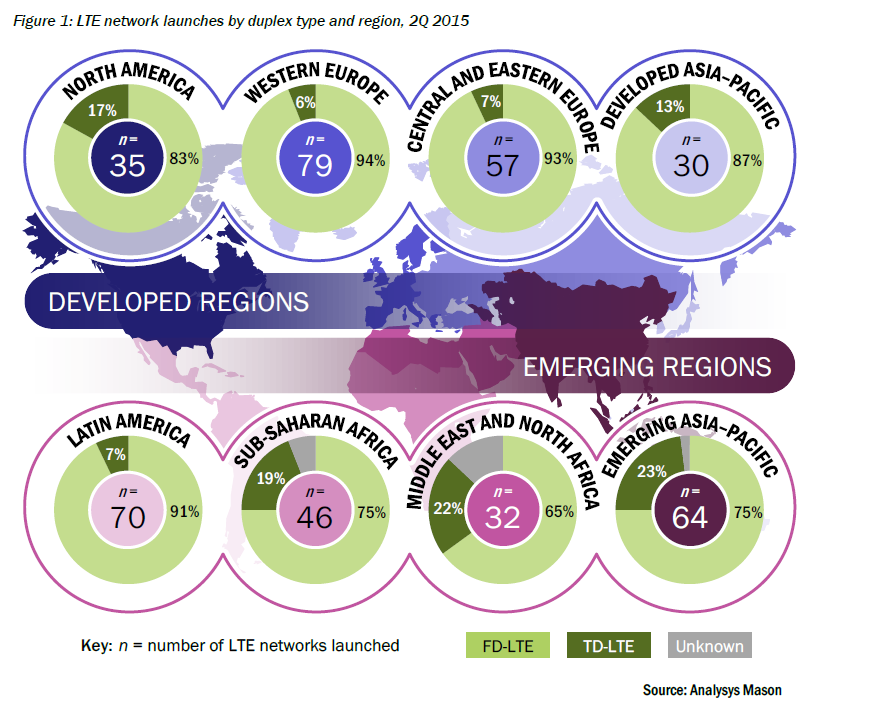
As per Analysis Mason, of the 413 commercial LTE networks that have been launched worldwide by the end of 2Q 2015, FD-LTE accounts for 348 (or 84%) of them, while TD-LTE accounts for only 55 (or 13%). Having said that, TD-LTE will be growing in market share, thanks to the unpaired spectrum that many operators secured during the auctions. This, combined with LTE-A Small Cells (as recently demoed by Nokia Networks) can help offload traffic from hotspots.

Light Reading had an interesting summary of TD-LTE rollouts and status that is further summarised below:
  • China Mobile has managed to sign up more than 200 million subscribers in just 19 months, making it the fastest-growing operator in the world today. It has now deployed 900,000 basestations in more than 300 cities. From next year, it is also planning to upgrade to TDD+ which combines carrier aggregation and MIMO to deliver download speeds of up to 5 Gbit/s and a fivefold improvement in spectrum efficiency. TDD+ will be commercially available next year and while it is not an industry standard executives say several elements have been accepted by 3GPP. 
  • SoftBank Japan has revealed plans to trial LTE-TDD Massive MIMO, a likely 5G technology as well as an important 4G enhancement, from the end of the year. Even though it was one of the world's first operators to go live with LTE-TDD, it has until now focused mainly on its LTE-FDD network. It has rolled out 70,000 FDD basestations, compared with 50,000 TDD units. But TDD is playing a sharply increasing role. The operator expects to add another 10,000 TDD basestations this year to deliver additional capacity to Japan's data-hungry consumers. By 2019 at least half of SoftBank's traffic to run over the TDD network.

According to the Analysis Mason article, Operators consider TD-LTE to be an attractive BWA (broadband wireless access) replacement for WiMAX because:

  • most WiMAX deployments use unpaired, TD spectrum in the 2.5GHz and3.5GHz bands, and these bands have since been designated by the 3GPP as being suitable for TD-LTE
  • TD-LTE is 'future-proof' – it has a reasonably long evolution roadmap and should remain a relevant and supported technology throughout the next decade
  • TD-LTE enables operators to reserve paired FD spectrum for mobile services, which mitigates against congestion in the spectrum from fixed–mobile substitution usage profiles.

For people who may be interested in looking further into migrating from WiMAX to TD-LTE, may want to read this case study here.


I have looked at the joint FDD-TDD CA earlier here. The following is from the 4G Americas whitepaper on Carrier Aggregation embedded here.

Previously, CA has been possible only between FDD and FDD spectrum or between TDD and TDD spectrum. 3GPP has finalized the work on TDD-FDD CA, which offers the possibility to aggregate FDD and TDD carriers jointly. The main target with introducing the support for TDD-FDD CA is to allow the network to boost the user throughput by aggregating both TDD and FDD toward the same UE. This will allow the network to boost the UE throughput independently from where the UE is in the cell (at least for DL CA).

TDD and FDD CA would also allow dividing the load more quickly between the TDD and FDD frequencies. In short, TDD-FDD CA extends CA to be applicable also in cases where an operator has spectrum allocation in both TDD and FDD bands. The typical benefits of CA – more flexible and efficient utilization of spectrum resources – are also made available for a combination of TDD and FDD spectrum resources. The Rel-12 TDD-FDD CA design supports either a TDD or FDD cell as the primary cell.

There are several different target scenarios in 3GPP for TDD-FDD CA, but there are two main scenarios that 3GPP aims to support. The first scenario assumes that the TDD-FDD CA is done from the same physical site that is typically a macro eNB. In the second scenario, the macro eNB provides either a TDD and FDD frequency, and the other frequency is provided from a Remote Radio Head (RRH) deployed at another physical location. The typical use case for the second scenario is that the macro eNB provides the FDD frequency and the TDD frequency from the RRH.

Nokia Networks were the first in the world with TDD-FDD CA demo, back in Feb 2014. In fact they also have a nice video here. Surprisingly there wasnt much news since then. Recently Ericsson announced the first commercial implementation of FDD/TDD carrier aggregation (CA) on Vodafone’s network in Portugal. Vodafone’s current trial in its Portuguese network uses 15 MHz of band 3 (FDD 1800) and 20 MHz of band 38 (TDD 2600). Qualcomm’s Snapdragon 810 SoC was used for measurement and testing.

3 Hong Kong is another operator that has revealed its plans to launch FDD-TDD LTE-Advanced in early 2016 after demonstrating the technology on its live network.

The operator used equipment supplied by Huawei to aggregate an FDD carrier in either of the 1800 MHz or 2.6 GHz bands with a TDD carrier in the 2.3 GHz band. 3 Hong Kong also used terminals equipped with Qualcomm's Snapdragon X12 LTE processor.

3 Hong Kong already offers FDD LTE-A using its 1800-MHz and 2.6-GHz spectrum, and is in the midst of deploying TD-LTE with a view to launching later this year.

The company said it expects devices that can support hybrid FDD-TDD LTE-A to be available early next year "and 3 Hong Kong is expected to launch the respective network around that time."

3 Hong Kong also revealed it plans to commercially launch tri-carrier LTE-A in the second half of 2016, and is working to aggregate no fewer than five carriers by refarming its 900-MHz and 2.1-GHz spectrum.

TDD-FDD CA is another tool in the network operators toolbox to help plan the network and make it better. Lets hope more operators take the opportunity to deploy one.