Showing posts with label White Papers and Reports. Show all posts

Thursday, October 29, 2026

How 3GPP Release 19 Optimises UE-Satellite-UE Voice and Video Communications

One of the interesting developments in 3GPP Release 19 is the introduction of optimised UE-Satellite-UE communications, allowing voice and video traffic between two satellite-connected devices to be routed through satellites without unnecessarily passing through the terrestrial core network.

We briefly covered this feature in our earlier discussion of Release 19 NTN enhancements, but a recent article (in Japanese) from the NTT DOCOMO Technical Journal, published in October 2026, provides a much more detailed explanation of the underlying 5G Core (5GC) and IP Multimedia Subsystem (IMS) architecture, along with the procedures needed to establish and maintain these communications.

The article, titled 5GC Enhancement Technologies for Satellite Communication Networks in 3GPP Release 19, explains how satellite-based user-plane functions, IMS media gateways and terrestrial control-plane functions work together to enable more efficient voice and video services.

To understand the significance of this development, it is worth briefly revisiting the evolution of 5G Non-Terrestrial Networks (NTN). Release 17 introduced NTN support based primarily on transparent satellite payloads, where satellites act as radio repeaters while the gNB and core network functions remain on the ground. Release 18 introduced core network architectural enhancements for regenerative GEO satellites, where additional processing and network functions can be located onboard. Release 19 further develops regenerative NTN architectures and supports scenarios involving LEO satellites with onboard user-plane functionality.

One problem with conventional satellite communication architectures is that even when two devices communicate through satellites belonging to the same constellation, their user traffic may still need to travel down to a terrestrial gateway, through the ground network, and then back up to the satellite serving the receiving device.

As shown in the diagram above, traffic from the originating UE travels to its serving satellite and across an inter-satellite link (ISL), before being routed through an NTN gateway and terrestrial 5GC. It then returns through the satellite network to reach the destination UE.

This introduces unnecessary satellite-to-ground and ground-to-satellite transmissions, increasing propagation delay and consuming feeder-link capacity. Depending on the constellation and routing arrangement, the additional latency can become significant, particularly for delay-sensitive applications such as voice and video calls.

Release 19 addresses this by allowing the media traffic to be routed locally through the satellite network, provided that the necessary network functions and inter-satellite connectivity are available. In the optimised arrangement, voice or video packets travel from one UE to its serving satellite, pass through satellite-based network functions and, when required, use inter-satellite links to reach the satellite serving the other UE. The traffic can therefore avoid traversing terrestrial network elements.

Importantly, this does not mean that the entire 5G Core or IMS network has been moved into space. This is probably the most interesting aspect of the architecture. The Release 19 solution places selected user-plane functions onboard the regenerative satellites, including the IMS Access Gateway (IMS-AGW), Uplink Classifier (UL-CL) and Local PDU Session Anchor (L-PSA). The IMS-AGW handles the media path associated with an IMS session. The UL-CL provides traffic classification and steering, allowing relevant packets to be directed towards the local satellite-based processing functions. The L-PSA provides the local user-plane anchoring needed for the optimised media path.

However, the main PDU Session Anchor (PSA) UPF remains on the ground. This is important because it allows the UE's IMS PDU session IP address to remain unchanged as the serving satellite changes. Similarly, IMS control-plane functions such as the Proxy Call Session Control Function (P-CSCF) and Serving Call Session Control Function (S-CSCF) remain terrestrial.

In other words, the network separates the handling of voice and video packets from the signalling and control functions used to establish and manage the communication. The media can remain in space even though the session is still controlled through the terrestrial network. The architecture also relies on coordination between IMS and the 5GC. It is not sufficient simply to install a UPF on a satellite. The network must determine which satellites are serving the two devices, whether optimised routing is possible, and where the relevant media processing functions should be configured.

The call establishment procedure uses familiar IMS signalling, with additional mechanisms to support satellite identification and media path selection. When a UE initiates a voice or video call, it sends a SIP INVITE message. The originating P-CSCF obtains information from the terrestrial 5GC identifying the satellite currently serving the UE. Initially, a terrestrial IMS-AGW is selected, providing a conventional media path while the network determines whether satellite optimisation is possible.

The satellite identifier is conveyed towards the terminating side through the IMS signalling procedures. The terminating P-CSCF also obtains the identity of the satellite serving the receiving UE. Using this information, the network determines whether both sides can support optimised satellite media routing. If the required conditions are satisfied, the P-CSCFs select satellite-based IMS-AGWs, release the initially allocated terrestrial gateways where appropriate, and coordinate with the 5GC to configure the UL-CL and L-PSA functions onboard the satellites.

The 5GC policy and session management mechanisms, including interaction with the Policy Control Function (PCF) and Session Management Function (SMF), help establish the necessary traffic steering and Quality of Service (QoS) treatment. Once the procedure is complete, the IMS voice or video media can travel through the satellite network rather than being routed through terrestrial gateways.

It is worth emphasising that this is not a direct device-to-device radio connection. Each device still communicates with its serving satellite using the normal satellite access interface. The optimisation takes place inside the satellite network, with the appropriate onboard user-plane functions handling the media traffic.

Another important consideration is mobility. Unlike a conventional terrestrial mobile network, where the base station is generally stationary, LEO satellites move continuously relative to the Earth's surface. Even a stationary user may need to change serving satellites frequently as satellites enter and leave the visible coverage area.

This creates an additional challenge for optimised UE-Satellite-UE communication. A voice or video call may already be using satellite-based IMS-AGWs and local user-plane functions when one of the devices changes its serving satellite. Simply transferring the radio connection to another satellite is not enough. The media path must also be updated so that packets continue to reach the correct gateway and user-plane functions.

Release 19 defines procedures for maintaining the optimised media path when the serving satellite changes, as well as falling back to terrestrial routing when satellite-based optimisation can no longer be maintained.

When a UE changes its serving satellite, the 5GC can provide an early notification to the P-CSCF containing the identity of the target satellite. The P-CSCF then determines whether optimised routing can continue between the new serving satellite and the satellite serving the other UE. If it can, the network selects an IMS-AGW on the target satellite and coordinates the necessary user-plane configuration.

The SMF manages the appropriate UL-CL and L-PSA configuration, while updated media transport information is provided for the continuing session. This allows the media route to change without requiring the user to establish a completely new call. There will, however, be situations where the optimised route cannot be maintained. For example, the required inter-satellite connectivity may not be available, or the new satellite arrangement may not support the necessary media path.

Rather than allowing the communication to fail simply because the optimised path is unavailable, Release 19 also supports a terrestrial fallback procedure.

In this case, the P-CSCF arranges for the media to be routed through a terrestrial IMS-AGW instead of continuing through the optimised satellite path. The relevant media transport information is updated and provided through the 5GC. Both continued satellite optimisation and terrestrial fallback require the IMS session to be updated. This is achieved through the SIP RE-INVITE procedure.

The IMS Application Server (IMS-AS) plays a role in coordinating this update. Following the change of media gateway, the IMS-AS initiates SIP RE-INVITE signalling so that the two sides can renegotiate the media transport addresses associated with the ongoing session. Depending on whether the network is maintaining satellite-based routing or falling back to the ground, the relevant IMS-AGWs and media paths are updated accordingly.

This is particularly important for LEO satellite systems, where changes in the serving satellite are a normal part of operation rather than an occasional event. The ability to relocate media functions and update traffic paths is essential for maintaining service continuity, although actual interruption performance will depend on network implementation and operating conditions.

There are also some important limitations to the Release 19 functionality. The standardised UE-Satellite-UE optimisation discussed here is restricted to IMS-based voice and video services involving two devices belonging to the same Public Land Mobile Network (PLMN), without roaming. It does not provide a general-purpose mechanism for arbitrary data communication between any two satellite-connected devices.

The requirement for satellite-based processing also means that the feature is intended for appropriately equipped regenerative satellite networks. It should not be confused with conventional transparent-payload direct-to-device services. NTT DOCOMO identifies support for additional services, including mission-critical communications and non-IMS data exchange, as areas for further development. Communication between different PLMNs and roaming scenarios also remains an important area for future standardisation, with related work being considered in Release 20.

From a network architecture perspective, this development is particularly interesting because it demonstrates how 5G is evolving towards more distributed processing. Instead of forcing all traffic through a centralised terrestrial network, selected user-plane and media functions can operate closer to the devices being served, even when those functions are located on moving satellites.

There are, of course, practical challenges. Satellite resources, onboard processing capabilities, inter-satellite connectivity, transport topology and coordination between terrestrial and non-terrestrial network functions will influence how such systems can be deployed. Standardising the architecture does not necessarily mean that operators have already implemented these capabilities commercially.

Nevertheless, the Release 19 enhancements represent an important step towards more tightly integrated terrestrial and non-terrestrial mobile networks. While the immediate focus is on optimising IMS voice and video communication, the underlying principles of distributed user-plane processing, dynamic media routing and service continuity are likely to remain relevant as NTN architectures evolve towards 6G.

For those interested in the detailed procedures, the original NTT DOCOMO article is well worth reading, particularly its signalling diagrams. The relevant 3GPP specifications include TS 23.501, which covers the 5G System architecture for UE-Satellite-UE communication, and TS 23.228, whose Annex AE addresses the IMS architecture and media routing procedures.

Related Posts: 

Tuesday, May 26, 2026

Mid-Band Spectrum Still Matters for 5G and Beyond

Mid-band spectrum has become one of the most important parts of the mobile network story. Low-band spectrum is essential for wide-area coverage and better indoor reach, while high-band spectrum, including mmWave, can provide very high capacity in selected locations. Mid-band sits between these two extremes and provides the practical balance of coverage and capacity that mobile operators need for mainstream LTE and 5G deployments.

A recent GSA report, Mid Band Spectrum Summary Report, May 2026, provides a useful global update on the status of spectrum between 1.71 GHz and 7.125 GHz. This includes familiar bands such as 1800 MHz, 2100 MHz, 2300 MHz, 2600 MHz, C-band, n79 and the upper 6 GHz band. Many of these bands have a long history in 2G, 3G and 4G networks, but they continue to remain valuable as operators refarm spectrum for LTE and 5G.

The 1800 MHz band remains one of the most widely used LTE bands globally, while 2100 MHz is a good example of a band originally associated with 3G that is now being reused for LTE and 5G. The 2300 MHz and 2600 MHz bands add further capacity options, with different FDD and TDD arrangements depending on the market.

For 5G, C-band has become the main global capacity layer. It offers more bandwidth than the lower mobile bands, while still being more practical than mmWave for wide-area deployment. This is why 3.5 GHz and related C-band ranges are central to many 5G network rollouts around the world.

Looking ahead, upper 6 GHz is becoming increasingly important for 5G-Advanced and 6G planning. It could provide an additional capacity layer that sits above today’s C-band deployments, while still being more practical than mmWave in many scenarios. Beyond that, future 6G discussions may add new layers such as upper-midband spectrum in the 7 to 15 GHz range and sub-THz spectrum for very high-throughput use cases.

In the short video below, we provide a quick update on mid-band spectrum, using the GSA report as the main data source and adding our own analysis of how these spectrum layers fit into LTE, 5G, 5G-Advanced and future 6G evolution.

Related Posts: 

Thursday, March 26, 2026

3GPP Study on Modernization of Specification Format and Procedures for 6G (6GSM)

The development of each new mobile generation is not only about new technologies and capabilities. It also requires evolution in the way standards themselves are created, maintained and consumed. As work on 6G gradually begins to take shape, the 3rd Generation Partnership Project (3GPP) has started examining whether the tools and processes used to write its specifications are still fit for purpose.

One of the first steps in this direction is the study titled Study on Modernization of Specification Format and Procedures for 6G (6GSM), documented in TR 21.802. The study looks at how the current approach to specification development works, the limitations that are becoming more visible as specifications grow larger and more complex, and the possible directions for modernising the process as the industry prepares for the 6G era.

3GPP specifications form the backbone of the mobile industry. They define how networks, devices and services interoperate across the globe. However, the way these specifications are produced has largely remained unchanged for many years. Today, most specifications are created and maintained using document based workflows centred around Microsoft Word and DOCX files. Delegates submit Change Requests that modify the text of these documents, and editors manually merge the approved changes into updated specification versions. This approach has served the industry well for decades because it is familiar, widely supported and easy for participants to understand.

The study recognises that the current workflow has several strengths. The document format provides a consistent structure across thousands of specifications. Contributors can edit content directly using familiar WYSIWYG tools, review tracked changes, include diagrams and tables, and collaborate during meetings by editing documents in real time on shared screens. These capabilities have helped large groups of experts work together efficiently during standardisation meetings.

At the same time, as specifications grow larger and more complex, the limitations of the current approach are becoming more visible. One of the most obvious challenges is the heavy reliance on manual processes. Change Requests must be merged into specifications by editors, which can introduce delays before updated versions are published. When multiple Change Requests modify the same sections of a document, identifying conflicts or inconsistencies can be difficult.

Scale is another factor. Many technical specifications now run into hundreds or even thousands of pages. Opening, searching or editing such large DOCX files can become slow and occasionally unstable. Large tables, embedded diagrams and complex formatting further increase file sizes and processing overhead.

Understanding how a feature evolves across specification versions can also be difficult for readers and implementers. Engineers often need to trace how a particular capability has changed between releases, but linking the final specification text back to the relevant Change Requests or understanding the context behind changes is not always straightforward.

The document format itself also presents challenges for automated processing. Extracting structured information from DOCX files requires significant preprocessing because textual content is mixed with binary elements such as images and embedded objects. This makes it harder for tools to analyse specifications or automate parts of the development workflow.

Navigation across specifications is another area where improvements could help. Many features are defined across multiple technical specifications produced by different working groups. Following references between documents or understanding how procedures interact across specifications can take time and effort, especially for engineers who are new to the standards.

To address these challenges, the study explores a number of alternative specification formats that could be considered for future work. Options such as OpenDocument, AsciiDoc, Markdown and LaTeX are discussed, along with more structured or restricted DOCX based approaches. Some proposals also consider hybrid models where different formats could coexist while maintaining a single authoritative source.

Text based markup formats such as Markdown or AsciiDoc are particularly interesting because they separate content from presentation. This structure can make version control and automated processing easier. These formats are widely used in software development environments and integrate well with modern collaboration tools that track changes and manage contributions from multiple participants.

LaTeX is another potential option, particularly for documents that require complex technical formatting or mathematical expressions. Meanwhile, restricted DOCX approaches attempt to preserve compatibility with existing workflows while enforcing stricter formatting rules to reduce complexity and improve consistency.

Beyond the document format itself, the study also looks at broader improvements to the way specifications are developed and maintained. One important idea is the use of modern version control systems such as Git. These systems are widely used in software development and allow contributors to track changes in detail, manage parallel development branches and merge updates in a more controlled manner. Applying similar workflows to standards development could improve traceability and help identify conflicts earlier.

The study also highlights the potential for automated validation tools that could check Change Requests for formatting errors, missing references or structural inconsistencies before they are submitted. Such tools could reduce the editorial workload while improving the overall quality and consistency of specifications.

Another possible direction is the use of machine readable formats for structured elements within specifications. Interfaces, protocol definitions or data models could be stored separately in structured files and then referenced or generated automatically within the main specification. This approach could reduce duplication and make it easier for implementers to reuse information directly in development environments.

The modernisation study does not recommend a single solution at this stage. Instead, it provides a detailed analysis of the current situation and explores possible directions for future work. Any transition will need to balance the benefits of new tools and formats with the practical realities of the existing ecosystem. The 3GPP community relies on a large set of established workflows, tools and expertise, and maintaining accessibility for all participants will be important.

As the industry moves towards 6G, the scale and complexity of specifications will continue to grow. Ensuring that the processes used to create and manage these specifications evolve alongside the technologies themselves will be essential. In that sense, modernising specification formats and procedures may become an important step in preparing the standards ecosystem for the next generation of mobile innovation.

If you want to learn more about this, check out:

  • 6G Specification Modernization discussions from Nokia & Ericsson here.
  • Ongoing 6GSM Workshop discussions here.
  • 3GPP TR 21.802: Study on modernization of specification format and procedures for 6G here.

Related Posts: 

Thursday, July 24, 2025

L4S and the Future of Real-Time Performance in 5G and Beyond

As mobile networks continue to evolve to support increasingly immersive and responsive services, the importance of consistent low latency has never been greater. Whether it is cloud gaming, extended reality, remote machine operation or real-time collaboration, all these applications rely on the ability to react instantly to user input. The slightest delay can affect the user experience, making the role of the network even more critical.

While 5G has introduced major improvements in radio latency and overall throughput, many time-critical applications are still affected by a factor that is often overlooked - queuing delay. This occurs when packets build up in buffers before they are forwarded, creating spikes in delay and jitter. Traditional methods for congestion control, such as those based on packet loss, are too slow to react, especially in mobile environments where network conditions can change rapidly.

Low Latency, Low Loss and Scalable Throughput (L4S), is a new network innovation designed to tackle this challenge. It is an Internet protocol mechanism developed through the Internet Engineering Task Force, and has recently reached standardisation. L4S focuses on preventing queuing delays by marking packets early when congestion is building, instead of waiting until buffers overflow and packets are dropped. The key idea is to use explicit signals within the network to guide congestion control at the sender side.

Applications that support L4S are able to reduce their sending rate quickly when congestion starts to appear. This is done by using ECN, or Explicit Congestion Notification, which involves marking rather than dropping packets. The result is a smooth and continuous flow of data, where latency remains low and throughput remains high, even in changing network conditions.

One of the significant benefits of L4S is its ability to support a wide range of real-time services at scale. Ericsson highlights how edge-based applications such as cloud gaming, virtual reality and drone control need stable low-latency connections alongside high bitrates. While over-the-top approaches to congestion control may work for general streaming, they struggle in mobile environments. This is due to variability in channel quality and radio access delays, which can cause sudden spikes in latency. L4S provides a faster and more direct way to detect congestion within the radio network, enabling better performance for these time-sensitive applications.

To make this possible, mobile networks need to support L4S in a way that keeps its traffic separate from traditional data flows. This involves using dedicated queues for L4S traffic to ensure it is not delayed behind bulk data transfers. In 5G, this is implemented through dedicated quality-of-service flows, allowing network elements to detect and handle L4S traffic differently. For example, if a mobile user is playing a cloud-based game, the network can identify this traffic and place it on an L4S-optimised flow. This avoids interference from other applications, such as file downloads or video streaming.

Nokia's approach further explains how L4S enables fair sharing of bandwidth between classic and L4S traffic without compromising performance. A dual-queue system allows both types of traffic to coexist while preserving the low-latency characteristics of L4S. This is especially important in scenarios where both legacy and L4S-capable applications are in use. In simulations and trials, the L4S mechanism has shown the ability to maintain very low delay even when the link experiences sudden reductions in capacity, which is common in mobile and Wi-Fi networks.

One of the important aspects of L4S is that it requires support both from the application side and within the network. On the application side, rate adaptation based on L4S can be implemented within the app itself, often using modern transport protocols such as QUIC or TCP extensions. Many companies, including device makers and platform providers, are already trialling support for this approach.

Within the network, L4S depends on the ability of routers and radio access equipment to read and mark ECN bits correctly. In mobile networks, the radio access network is typically the key bottleneck where marking should take place. This ensures that congestion is detected at the right point in the path, allowing for quicker response and improved performance.

Although L4S is distinct from ultra-reliable low-latency communication, it can complement those use cases where guaranteed service is needed in controlled environments. What makes L4S more versatile is its scalability and suitability for open internet and large-scale public network use. It can work across both fixed and mobile access networks, providing a common framework for interactive services regardless of access technology.

With L4S in place, it becomes possible to offer new kinds of applications that were previously limited by latency constraints. This includes lighter and more wearable XR headsets that can offload processing to the cloud, or port automation systems that rely on remote control of heavy equipment. Even everyday experiences, such as video calls or online gaming, stand to benefit from a more responsive and stable network connection.

Ultimately, L4S offers a practical and forward-looking approach to delivering the consistent low latency needed for the next generation of digital experiences. By creating a tighter feedback loop between the network and the application, and by applying congestion signals in a more intelligent way, L4S helps unlock the full potential of 5G and future networks.

This introductory video by CableLabs is a good starting point for anyone willing to dig deeper in the topic. This LinkedIn post by Dean Bubley and the comments are also worth a read.

PS: Just noticed that T-Mobile USA have announced earlier this week that they are the first to unlock L4S in wireless . You can read their blog post here and a promotional video is available in the Tweet below ðŸ‘‡

Wednesday, January 4, 2023

How Many People are Still Unconnected in 2023 and Why?

I hear in many presentations that half the world is still unconnected so we need a solution XYZ. In this post I will explore how many people are really unconnected and why.

GSMA produces an annual report called "The State of Mobile Internet Connectivity Report". The latest issue from Nov 2022 explains the number of people that are still unconnected because of coverage gap or the usage gap. Quoting from the report:

(click to expand the image)

By the end of 2021, 4.3 billion people were using mobile internet, representing 55% of the world’s population, up from 31% in 2014 (see Figure 1). This translates into almost 300 million people coming online in the past year. Most of the people who started using mobile internet in 2021 came from LMICs (low and middle-income countries), where 94% of the unconnected population live.

By the end of 2021, the share of the world’s population living in areas without mobile broadband coverage stood at 5%, meaning that 400 million people are still not covered by a mobile broadband network. Since 2018, this coverage gap has reduced by only 1 pp a year (see Figure 1), highlighting how the remaining uncovered communities – which are predominantly rural, poor and sparsely populated – are the most challenging to reach in a financially sustainable manner. For example, in least developed countries (LDCs) almost 30% of people living in rural areas are still not covered by a mobile broadband network.

A much larger proportion of the unconnected live in areas already covered by mobile broadband networks. By the end of 2021, 40% of the world’s population (3.2 billion people) were living within the footprint of a mobile broadband network but not using mobile internet. While this usage gap remained relatively unchanged between 2014 and 2019, it declined by 300 million people (or 5 pp) over the past two years. However, the usage gap remains substantial and is now almost eight times the size of the coverage gap. It is worth noting that these numbers are for the total population, some of whom would never be expected to use the internet (e.g. young infants). Indeed, taking adults (18 years old and above) only, the usage gap stands at 25%, a much smaller though still significant gap.

The report further expands the reasons for usage gap as shown below:

(click to enlarge)

As can be seen, the reasons have been grouped in 5 major categories as follows:

  • Literacy and digital skills
    • I do not know how to access the internet on a mobile phone
    • I have difficulties with reading and writing
    • I find it difficult to use a mobile in general (calling, texting or mobile internet)
    • I do not have time to learn how to use the internet on a mobile phone
    • There is nobody to teach or help me to use mobile internet
  • Relevance
    • There is not enough in my own language on the internet
    • I do not find the internet relevant enough for me (not useful or not interesting)
  • Affordability
    • The cost of buying a mobile phone that can access the internet is too high for me
    • The cost of buying data to use the internet on my mobile is too high for me
  • Safety and security
    • I am concerned that I would receive unwanted contact from people online (e.g. scam emails or unwanted messages)
    • I am concerned that it might expose myself or my family to harmful content
    • I am concerned that my identity or other private information will be stolen or misused
  • Access
    • There is limited or no coverage to access the internet in my area
    • Using the internet on my mobile phone is too slow (e.g. connection speeds)
    • My family does not approve of me using the internet on a mobile phone
    • It is hard to find a mobile phone agent or representative to buy mobile internet data from
    • Using the internet on my mobile phone uses too much battery
    • I cannot borrow or pay to use internet on another person’s phone
    • It is hard to find somewhere to buy a mobile phone which is able to connect to the internet

There are many reports of blackmail and extortion cases in India that are linked to mobile phones and internet. You can read about them here and here. These also discourage a lot of people to embrace smartphones, especially women.  

Although women account for close to half the world's population, according to a UN report on gender digital divide, 259 million fewer women have access to the Internet than men in 2022. 

I hope that the next time presenters are talking about the number of unconnected people, they put things in context and mention the connectivity and the usage gap. 

Finally, here is a webinar recording from M4D discussing the latest trends in global connectivity from The State of Mobile Internet Connectivity Report 2022:

Related Posts: 

Saturday, September 10, 2022

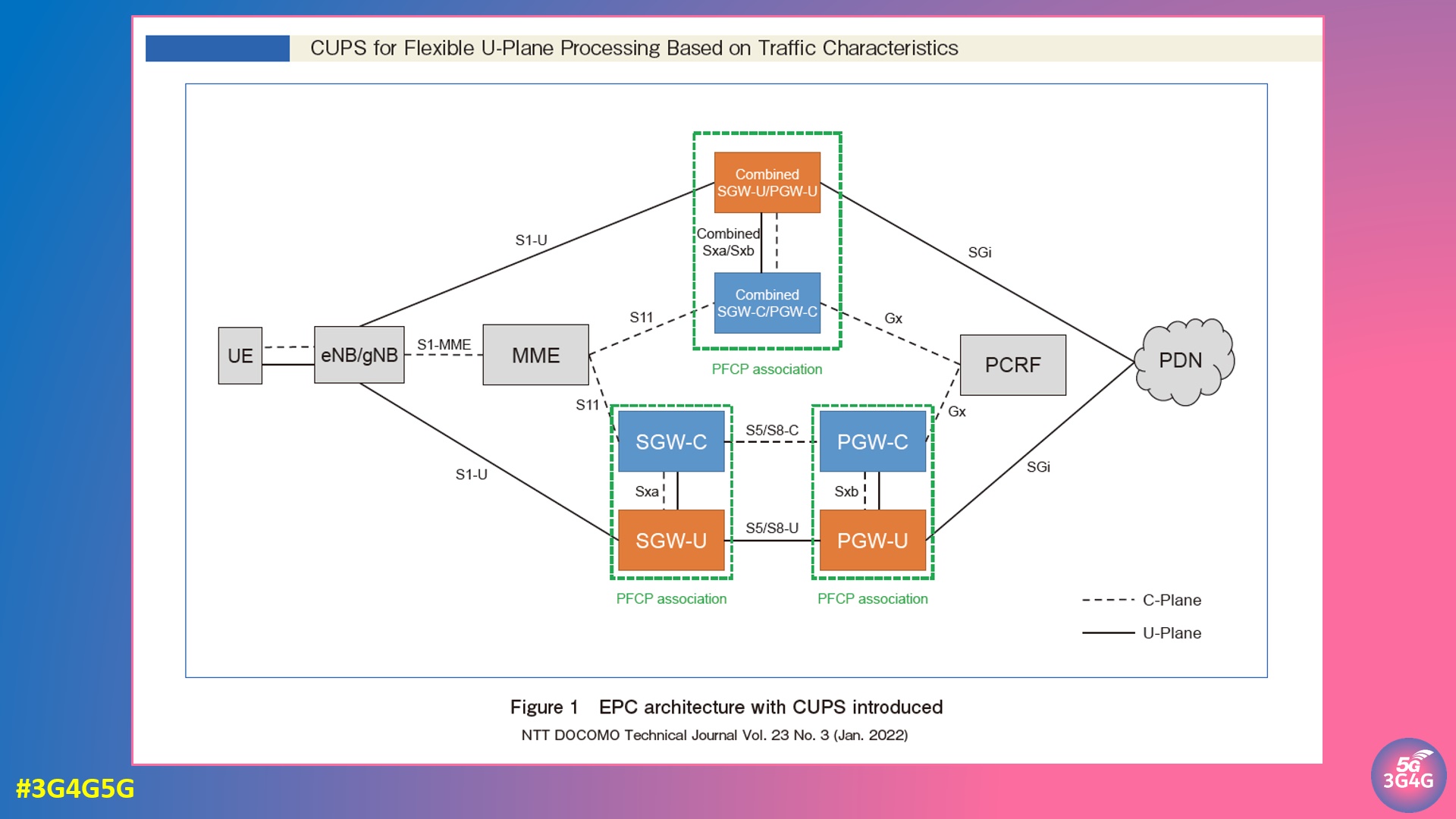
CUPS for Flexible U-Plane Processing Based on Traffic Characteristics

I looked at Control and User Plane Separation (CUPS) in a tutorial, nearly five years back here. Since then most focus has been on 5G, not just on my blogs but also from the industry. 

Earlier this year, NTT Docomo's Technical Journal looked at CUPS for Flexible U-Plane Processing Based on Traffic Characteristics. The following is an extract from the article:

At the initial deployment phase of 5th Generation mobile communication systems (5G), the 5G Non-Stand-Alone (NSA) architecture was widely adopted to realize 5G services by connecting 5G base stations to the existing Evolved Packet Core (EPC). As applications based on 5G become more widespread, the need for EPC to achieve higher speed and capacity communications, lower latency communications and simultaneous connection of many terminals than ever has become urgent. Specifically, it is necessary to increase the number of high-capacity gateway devices capable of processing hundreds of Gbps to several Tbps to achieve high-speed, high-capacity communications, to distribute gateway devices near base station facilities to achieve even lower latency communications, and to improve session processing performance for connecting massive numbers of terminals simultaneously.

Conventional single gateway devices have both Control Plane (C-Plane) functions to manage communication sessions and control communications, and User Plane (U-Plane) functions to handle communications traffic. Therefore, if the previously assumed balance between the number of sessions and communications capacity is disrupted, either the C-Plane or the U-Plane will have excess processing capacity. In high-speed, high-capacity communications, the C-Plane has excess processing power, and in multiple terminal simultaneous connections, the U-Plane has excess processing power because the volume of communications is small compared to the number of sessions. If the C-Plane and U-Plane can be scaled independently, these issues can be resolved, and efficient facility design can be expected. In addition, low-latency communications require distributed deployment of the U-Plane function near the base station facilities to reduce propagation delay. However, in the distributed deployment of conventional devices with integrated C-Plane and U-Plane functions, the number of sessions and communication volume are unevenly distributed among the gateway devices, resulting in a decrease in the efficiency of facility utilization. Since there is no need for distributed deployment of C-Plane functions, if the C-Plane and U-Plane functions can be separated and the way they are deployed changed according to their characteristics, the loss of facility utilization efficiency related to C-Plane processing capacity could be greatly reduced.

CUPS is an architecture defined in 3GPP TS 23.214 that separates the Serving GateWay (SGW)/Packet data network GateWay (PGW) configuration of the EPC into the C-Plane and U-Plane. The CUPS architecture is designed so that there is no difference in the interface between the existing architecture and the CUPS architecture - even with CUPS architecture deployed in SGW/PGW, opposing devices such as a Mobility Management Entity (MME), Policy and Charging Rules Function (PCRF), evolved NodeB (eNB)/ next generation NodeB (gNB), and SGWs/PGWs of other networks such as Mobile Virtual Network Operator (MVNO) and roaming are not affected. For C-Plane, SGW Control plane function (SGW-C)/PGW Control plane function (PGW-C), and for U-Plane, SGW User plane function (SGW- U)/PGW User plane function (PGW-U) are equipped with call processing functions. By introducing CUPS, C-Plane/U-Plane capacities can be expanded individually as needed. Combined SGW-C/PGW-C and Combined SGW-U/PGW-U can handle the functions of SGW and PGW in common devices. In the standard specification, in addition to SGW/PGW, the Traffic Detection Function (TDF) can also be separated into TDF-C and TDF-U, but the details are omitted in this article.

From above background, NTT DOCOMO has been planning to deploy Control and User Plane Separation (CUPS) architecture to realize the separation of C-Plane and U-Plane functions as specified in 3rd Generation Partnership Project Technical Specification (3GPP TS) 23.214. Separating the C-Plane and U-Plane functions of gateway devices with CUPS architecture makes it possible to scale the C-Plane and U-Plane independently and balance the centralized deployment of C-Plane functions with the distributed deployment of U- Plane functions, thereby enabling the deployment and development of a flexible and efficient core network. In addition to solving the aforementioned issues, CUPS will also enable independent equipment upgrades for C-Plane and U-Plane functions, and the adoption of U-Plane devices specialized for specific traffic characteristics.

In the user perspective, the introduction of CUPS can be expected to dramatically improve the user experience through the operation of facilities specializing in various requirements, and enable further increases in facilities and lower charges to pursue user benefits by improving the efficiency of core network facilities.

Regarding the CUPS architecture, a source of value for both operators and users, this article includes an overview of the architecture, additional control protocols, U-Plane control schemes based on traffic characteristics, and future developments toward a 5G Stand-Alone (5G SA) architecture.

The article is available here.

Related Posts: 

Monday, August 22, 2022

DCCA Features and Enhancements in 5G New Radio

In another new whitepaper on 5G-Advanced, Nokia has detailed DCCA (DC + CA) features and enhancements from Rel-15 until Rel-18. The following is an extract from the paper:

Mobility is one of the essential components of 5G-Advanced. 3GPP has already defined a set of functionalities and features that will be a part of the 5G-Advanced Release 18 package. These functionalities can be grouped into four areas: providing new levels of experience, network extension into new areas, mobile network expansion beyond connectivity, and providing operational support excellence. Mobility enhancements in Release 18 will be an important part of the ‘Experience enhancements” block of features, with the goal of reducing interruption time and improving mobility robustness.

Fig. 2 shows a high-level schematic of mobility and dual connectivity (DC)/Carrier Aggregation (CA) related mechanisms that are introduced in the different 5G legacy releases towards 5G-Advanced in Release 18. Innovations such as Conditional Handover (CHO) and dual active protocol stack (DAPS) are introduced in Release 16. More efficient operation of carrier aggregation (CA), dual connectivity (DC), and the combination of those denoted as DCCA, as well as Multi-Radio Access Technology DC (MR-DC) are introduced through Releases 16 and 17.

For harvesting the full benefits of CA/DC techniques, it is important to have an agile framework where secondary cell(s) are timely identified and configured to the UE when needed. This is of importance for non-standalone (NSA) deployments where a carrier on NR should be quickly configured and activated to take advantage of 5G. Similarly, it is of importance for standalone (SA) cases where e.g. a UE with its Primary Cell (PCell) on NR Frequency Range 1 (FR1) wants to take additional carriers, either on FR1 and/or FR2 bands, into use. Thus, there is a need to support cases where the aggregated carriers are either from the same or difference sites. The management of such additional carriers for a UE shall be highly agile in line with the user traffic and QoS demands; quickly enabling usage of additional carriers when needed and again quickly released when no longer demanded to avoid unnecessary processing at the UE and to reduce its energy consumption. This is of particular importance for users with time-varying traffic demands (aka burst traffic conditions).

In the following, we describe how such carrier management is gradually improved by introducing enhancements for cell identification, RRM measurements and reduced reporting delays from UEs. As well as innovations related to Conditional PSCell Addition and Change (CPAC) and deactivation of secondary cell groups are outlined.

The paper goes on to discuss the following scenarios in detail for DCCA enhancements:

  • Early measurement reporting
  • Secondary cell (SCell) activation time improvements
    • Direct SCell activation
    • Temporary RS (TRS)-based SCell Activation
  • Conditional Secondary Node (SN) addition and change for fast access
  • Activation of secondary cell group

The table below summarizes the DCCA features in 5G NR

Related Posts: 

Tuesday, August 16, 2022

Managing 5G Signalling Storms with Service Communication Proxy (SCP)

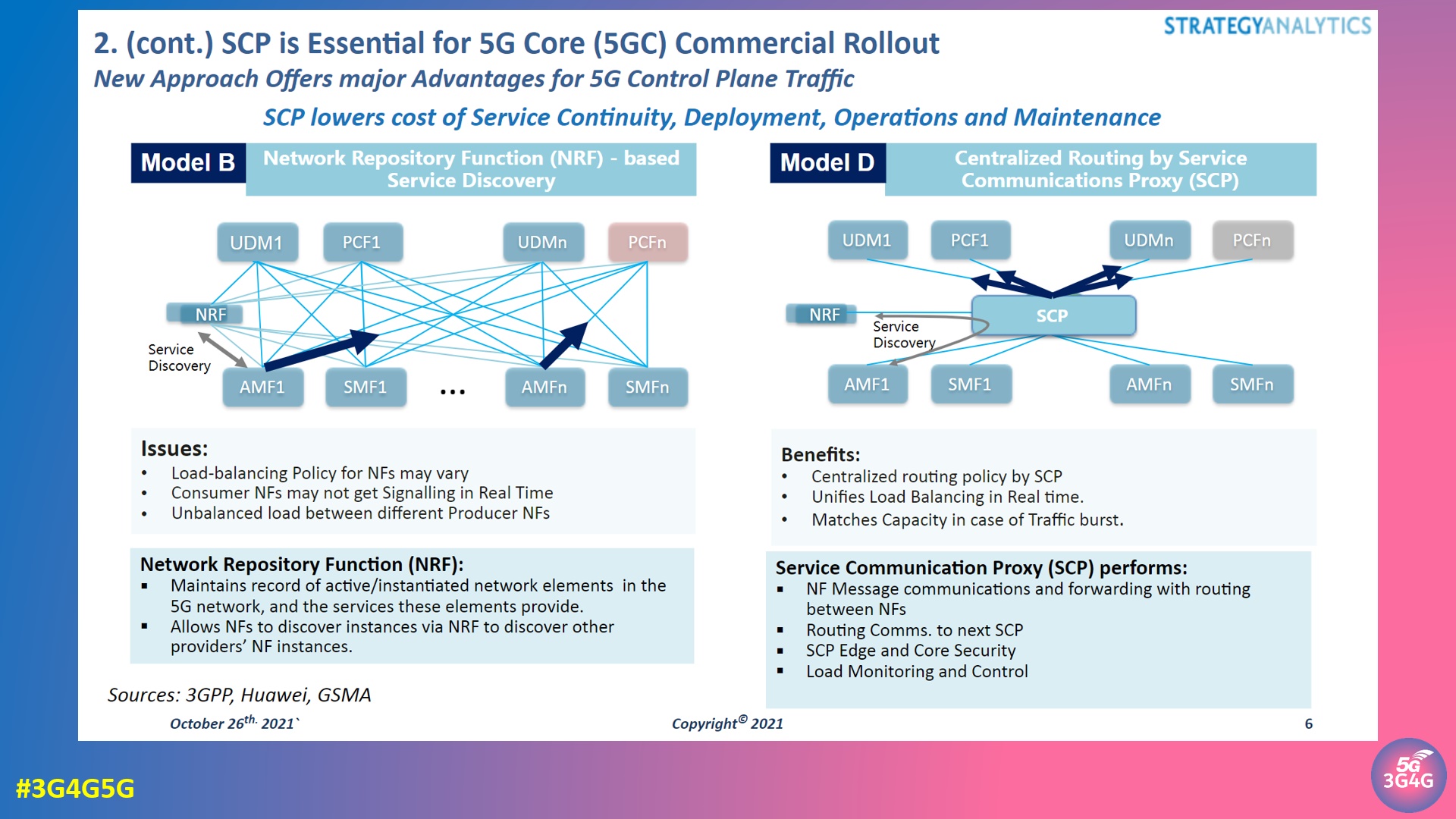
When we made our 5G Service Based Architecture (SBA) tutorial some four years back, it was based on Release-15 of the 3GPP standards. All Network Functions (NFs) simply sent discovery requests to the Network Repository Function (NRF). While this works great for trials and small scale deployments it can also lead to issues as can be seen in the slide above.

In 3GPP Release-16 the Service Communication Proxy (SCP) has now been introduced to allow the Control Plane network to handle and prioritize massive numbers of requests in real time. The SCP becomes the control point that mediates all Signalling and Control Plane messages in the network core.

SCP routing directs the flow of millions of simultaneous 5G function requests and responses for network slicing, microservice instantiation or edge compute access. It also plays a critical role in optimizing floods of discovery requests to the NRF and in overall Control Plane load balancing, traffic prioritization and message management.

A detailed whitepaper on '5G Signaling and Control Plane Traffic Depends on Service Communications Proxy (SCP)' by Strategy Analytics is available on Huawei's website here. This report was a follow on from the 'Signaling — The Critical Nerve Center of 5G Networks' webinar here.

Related Posts:

Wednesday, August 10, 2022

AI/ML Enhancements in 5G-Advanced for Intelligent Network Automation

Artificial Intelligence (AI) and Machine Learning (ML) has been touted to automate the network and simplify the identification and debug of issues that will arise with increasing network complexity. For this reason 3GPP has many different features that are already present in Release-17 but are expected to evolve further in Release-18. 

I have already covered some of this topics in earlier posts. Ericsson's recent whitepaper '5G Advanced: Evolution towards 6G' also has a good summary on this topic. Here is an extract from that:

Intelligent network automation

With increasing complexity in network design, for example, many different deployment and usage options, conventional approaches will not be able to provide swift solutions in many cases. It is well understood that manually reconfiguring cellular communications systems could be inefficient and costly.

Artificial intelligence (AI) and machine learning (ML) have the capability to solve complex and unstructured network problems by using a large amount of data collected from wireless networks. Thus, there has been a lot of attention lately on utilizing AI/ML-based solutions to improve network performance and hence providing avenues for inserting intelligence in network operations.

AI model design, optimization, and life-cycle management rely heavily on data. A wireless network can collect a large amount of data as part of its normal operations. This provides a good base for designing intelligent network solutions. 5G Advanced addresses how to optimize the standardized interfaces for data collection while leaving the automation functionality, for example, training and inference up to the proprietary implementation to support full flexibility in the automation of the network.

AI/ML for RAN enhancements

Three use cases have been identified in the Release 17 study item related to RAN performance enhancement by using AI/ML techniques. Selected use cases from the Release 17 technical report will be taken into the normative phase in the next releases. The selected use cases are: 1) network energy saving; 2) load balancing; and 3) mobility optimization.

The selected use cases can be supported by enhancements to current NR interfaces, targeting performance improvements using AI/ML functionality in the RAN while maintaining the 5G NR architecture. One of the goals is to ensure vendor incentives in terms of innovation and competitiveness by keeping the AI model implementation specific. As shown in Fig.2 (on the top) an intent-based management approach can be adopted for use cases involving RAN-OAM interactions. The intent will be received by the RAN. The RAN will need to understand the intent and trigger certain functionalities as a result.

AI/ML for physical layer enhancements

It is generally expected that AI/ML functionality can be used to improve the radio performance and/or reduced the complexity/overhead of the radio interface. 3GPP TSG RAN has selected three use cases to study the potential air interface performance improvements through AI/ML techniques, such as beam management, channel state information feedback enhancement, and positioning accuracy enhancements for different scenarios. The AI/ML-based methods may provide benefits compared to traditional methods in the radio interface. The challenge will be to define a unified AI/ML framework for the air interface by adequate AI/ML model characterization using various levels of collaboration between gNB and UE.

AI/ML in 5G core

5G Advanced will provide further enhancements of the architecture for analytics and on ML model life-cycle management, for example, to improve correctness of the models. The advancements in the architecture for analytics and data collection serve as a good foundation for AI/ML-based use cases within the different network functions (NFs). Additional use cases will be studied where NFs make use of analytics with the target to support in their decision making, for example, network data analytics functions (NWDAF)- assisted generation of UE policy for network slicing.

If you are interested in studying this topic further, check out 3GPP TR 37.817: Study on enhancement for data collection for NR and ENDC. Download the latest version from here.

Related Posts: 

Monday, March 7, 2022

GSMA Releases Mobile Economy Report 2022

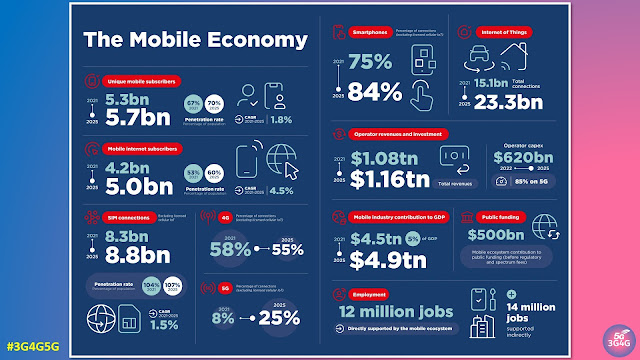
The GSMA Mobile Economy report series provides the latest insights on the state of the mobile industry worldwide. Produced by GSMA's in-house research team, GSMA Intelligence, these reports contain a range of technology, socio-economic and financial datasets, including forecasts out to 2025. The global version of the report is published annually at MWC Barcelona, while regional editions are published throughout the year.

The Infographic above (PDF) shows the latest update from 2022. The PDF of report is available here.

Selective extract from the executive summary as follows:

The mobile industry has been instrumental in extending connectivity to people around the world. In 2021, the number of mobile internet subscribers reached 4.2 billion people globally. Operators’ investments in network infrastructure over the last decade have helped to shrink the coverage gap for mobile broadband networks from a third of the global population to just 6%. But although the industry continues to invest in innovative solutions and partnerships to extend connectivity to still underserved and far-flung communities, the adoption of mobile internet services has not kept pace with the expansion of network coverage. This has resulted in a significant usage gap. In 2021, the usage gap stood at 3.2 billion people, or 41% of the global population. 

The reasons for the usage gap are multifaceted and vary by region, but they generally relate to a lack of affordability, relevance, knowledge and skills, in addition to safety and security concerns. Furthermore, the barriers to mobile internet adoption are particularly acute among certain segments of the population, including women, the elderly, those in rural areas and persons with disabilities – or a combination thereof. Addressing the usage gap for these key groups will extend the benefits of the internet and digital technology to more people in society, and will require concerted efforts by a broad range of stakeholders working together with mobile operators and other ecosystem players, such as device manufacturers and digital content creators.

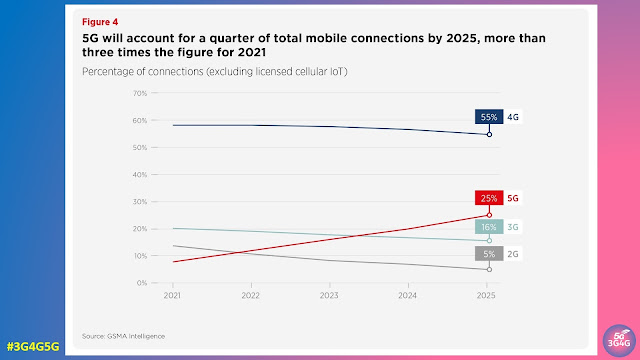
5G adoption continues to grow rapidly in pioneer markets, with the total number of connections set to reach 1 billion in 2022. Momentum has been boosted by a number of factors, including the economic recovery from the pandemic, rising 5G handset sales, network coverage expansions and overall marketing efforts by mobile operators. Meanwhile, a new wave of 5G rollouts in large markets with modest income levels (such as Brazil, Indonesia and India) could further incentivise the mass production of more affordable 5G devices, which in turn could further bolster subscriber growth. By the end of 2025, 5G will account for around a quarter of total mobile connections and more than two in five people around the world will live within reach of a 5G network.

4G still has room to grow in most developing markets, particularly in SubSaharan Africa, where 4G adoption is still below a fifth of total connections and operators are stepping up efforts to migrate existing 2G and 3G customers to 4G networks. However, rising 5G adoption in leading markets, such as China, South Korea and the US, means that 4G adoption on a global level is beginning to decline. Globally, 4G adoption will account for 55% of total connections by 2025, down from a peak of 58% in 2021.

By the end of 2021, 5.3 billion people subscribed to mobile services, representing 67% of the global population. In a growing number of markets, most adults now own a mobile phone, meaning that future growth will come from younger populations taking out a mobile subscription for the first time. Over the period to 2025, there will be an additional 400 million new mobile subscribers, most of them from Asia Pacific and Sub-Saharan Africa, taking the total number of subscribers to 5.7 billion (70% of the global population). 

In 2021, mobile technologies and services generated $4.5 trillion of economic value added, or 5% of GDP, globally. This figure will grow by more than $400 billion by 2025 to nearly $5 trillion as countries increasingly benefit from the improvements in productivity and efficiency brought about by the increased take-up of mobile services. 5G is expected to benefit all economic sectors of the global economy during this period, with services and manufacturing experiencing the most impact.

You can download all reports from here.

For anyone interested in keeping a track of which 2G/3G networks are undergoing sunset, you can follow my Twitter thread that lists all the networks I become aware of 

Related Posts: 

Thursday, November 11, 2021

Network Slicing using User Equipment Route Selection Policy (URSP)

Google announced that its latest smartphone OS will include support for 5G network slicing. Last week Telecom TV brought this news to my attention. The article explains:

It's a move designed to leverage its expertise in devices in order to give it the edge over its rival hyperscalers.

It comes in two flavours. The first is for enterprise-owned handsets, and routes all data sent and received by a device over the network slices provided by that company's mobile operator. Android 12 gives operators the ability to manage slices using a new dynamic policy control mechanism called User Equipment Route Selection Policy (URSP). URSP enables devices to automatically switch between different network slices according to which application they are using. For example, someone working for a financial institution might require a highly-secure network slice for sending and receiving sensitive corporate data, but will then require a reliable, high-throughput, low-latency slice so they can participate in a video meeting.

The second flavour is implemented in the work profile. For years, enterprises have had the option of creating work profiles on Android devices – irrespective of whether they are owned by the organisation or the individual – to use as a separate repository for enterprise apps and data. When Android 12 comes out next year, enterprises will be able to route data to and from that repository over a network slice.

Google said it has already carried out network slicing tests with both Ericsson and Nokia using test versions of its recently released Pixel 6 smartphone running on the as-yet-unreleased Android 12 OS.

Last week Taiwanese operator Far EasTone (FET) and Ericsson announced they have completed the world’s first proof of concept (PoC) for simultaneously connecting multiple network slices per device running on Android 12 commercial release. The press release said:

The trial, carried out on FET’s 5G standalone (SA) infrastructure built on Ericsson’s radio access network and cloud-native Core network, successfully demonstrated the 5G user equipment slicing policy feature (User Equipment Route Selection Policy, or URSP) on multiple Android devices. This marks a breakthrough in network slicing capabilities on a 5G standalone network and paves the way for further ecosystem development in this important area.

With more 5G networks evolving to standalone architecture around the globe, end-to-end network slicing, which includes Ericsson RAN Slicing to secure Quality of Service (QoS) differentiation, plays a key role in enabling new services for end users, with which multiple virtual 5G networks are created on top of one physical network. The 5G trial, in collaboration with FET, Ericsson and Android, went even further in network slicing capabilities by introducing and demonstrating 5G user equipment (UE) slicing policy (URSP) features that allow devices to simultaneously operate on dynamic policy control and selection between multiple 5G network slices. This enables the steering of applications and services with specific requirements to defined slices without switching devices.

Multiple slices allow devices to have multiple profiles to secure different levels of experience, security, and privacy requirements, based on the needs of the different applications and in correspondence with the user profile.  For instance, a device can have a personal profile with private data from apps or off-work entertainment, and a work profile with enterprises productivity apps. With URSP features, employers can customize the work profile with increased security and enable better use of RAN Slicing with QoS so that enterprise-related apps can work even during network congestion.

Some security-sensitive apps, such as mobile banking, can also benefit from different routing mechanisms of the traffic enabled by URSP. For instance, the banking app would not need to send its traffic to the internet and then to the app server as it does today. Instead, it could go straight to the app server and avoid the routing through internet. With the shortest route by connecting to a defined slice, users could reduce the risk of being attacked by hackers.

In their technical whitepaper on Network Slicing, Samsung explains: 

Along with the concept of network slicing and features in the RAN and Core network, UE Route Selection Policy (URSP) is introduced as a way to manage network slice information for the UE. URSP is a network slice feature enabled by the PCF which informs the network slice status to the UE via the AMF. In 4G network systems, it was near impossible to install new services in the network for a UE. But through the URSP feature, 5G network operators can easily configure new service for a UE. Figure 12 (top of this blog post) shows the difference in network slice selection in 4G and 5G Network. In 5G network, slice selection policy can be configured dynamically through URSP, while slice selection policy is pre-defined and cannot be changed dynamically in 4G network.

URSP contains OSId, AppId, IP descriptors to define the application and Single-Network Slice Selection Assistance Information (S-NSSAI), Data Network Name (DNN), Session and Service Continuity (SSC) mode information for the application and network slice mapping.

The S-NSSAI identifies each network slice service and provides information to properly assign network slice/functions. An S-NSSAI is comprised of:

  • A Slice/Service type (SST), which refers to the expected network slice behavior in terms of features and services;
  • A Slice Differentiator (SD), which is an optional information that complements the Slice/Service type(s) to differentiate amongst multiple network slices of the same Slice/Service type.

3GPP allows the use of the Slice Differentiator (SD) field that can build customized network slices. The SD field can be used to describe services, customer information and priority.

Here is a short video from Mpirical explaining 5G UE Route Selection.

It it worth reminding here that this feature, like many of the other 5G features, is dependent on 5G Core. We hope that the transition to 5G Standalone Networks happens as soon as possible.

Related Posts: