Energy efficiency has become one of the most important topics in mobile networks. Operators need to support growing traffic, wider bandwidths, massive MIMO, better coverage and new services, while also reducing energy consumption, managing cost and meeting sustainability targets.
We have put together a five-part video series looking at Energy Efficiency Improvements in 3GPP Technologies, starting with LTE and then moving through 5G NR, 5G-Advanced Release 18 and 3GPP Release 19.
The aim of the series is to explain the topic in a structured way. Energy saving in mobile networks is not simply about switching equipment off. It requires careful coordination between radio design, traffic load, user experience, QoS, mobility, device behaviour, RAN hardware, network policies and service requirements.
The five videos in the playlist are:
Energy Efficiency in Mobile Networks: The Basics - This introductory video explains why energy efficiency matters, why the RAN gets most attention, how energy saving differs from energy efficiency, and why measurements and KPIs are essential before optimisation.
How LTE Networks Save Energy - This video looks at LTE energy-saving mechanisms including dormant mode, carrier switch-off, secondary antenna deactivation, common channel power control, Cell DTX, compensation cells, and OAM or signalling-based control.
Why 5G NR Is More Energy Efficient by Design - This part explains the energy-efficiency improvements built into 5G NR, including lean carrier design, sleep opportunities, Bandwidth Parts, carrier aggregation, UE DRX, massive MIMO, beamforming and radio hardware evolution.
5G-Advanced Release 18 Network Energy Saving - This video looks at Release 18 Network Energy Saving features such as SSB-less SCells, Cell DTX/DRX, CSI enhancements, antenna adaptation, PDSCH power adaptation, Conditional Handover for NES cells and legacy UE handling.
3GPP Release 19 Energy Efficiency and Energy Saving - The final video looks at Release 19 enhancements including on-demand SSB operation for SCells, on-demand SIB1 for idle/inactive UEs, SSB periodicity adaptation, PRACH and paging adaptation, LP-WUS/WUR, Energy Information Function, OAM, slicing, charging and energy efficiency as a service criterion.
The overall message from the series is that mobile network energy efficiency has evolved from relatively simple resource switch-off mechanisms towards more intelligent, adaptive and service-aware optimisation. LTE introduced many of the early practical ideas. 5G NR provided a more flexible and energy-efficient foundation. 5G-Advanced Release 18 made RAN Network Energy Saving more explicit, and Release 19 expands the topic towards on-demand signalling, UE wake-up efficiency and system-wide energy awareness.
Back in 2024, I came across an excellent GSMA APAC webinar looking at the evolution of critical communications from predominantly voice-centric systems towards broadband, data-driven solutions. I had intended to write about it at the time but, as often happens, it remained on my ever-growing list of potential blog posts.
Watching it again in 2026, what struck me was not how much of it had become dated, but how relevant its central message remains.
The transition is not a simple replacement of TETRA, P25 and other narrowband systems with 4G and 5G. For many public safety and critical industry users, the more realistic path is a long period of coexistence, convergence and interworking.
Traditional narrowband critical communication systems were built around some very demanding requirements. Coverage and availability must be there 24 hours a day, 365 days a year. Different agencies need to communicate during major incidents. Group communications are fundamental. Security, reliability and resilience are essential. Devices must also be fit for purpose, whether they are being used by police officers, firefighters, ambulance crews or workers in other critical industries.
Broadband does not remove any of those requirements. Instead, it adds another layer of expectations.
Public safety and critical industry users increasingly need access to high-resolution video, mapping, live location, sensor information, databases, drones, body-worn cameras and other sources of real-time information. Voice remains essential, but it is no longer sufficient on its own.
This is why 3GPP Mission Critical Services, generally referred to collectively as MCX, are so important. Mission Critical Push-to-Talk, Mission Critical Video and Mission Critical Data provide a standards-based framework for extending critical communications beyond traditional voice services.
The Critical Communications Association, TCCA, highlighted an important reality during the webinar. Narrowband and broadband systems will coexist for many years. Some organisations are augmenting existing systems with commercial mobile networks, others are deploying dedicated broadband networks, and many are adopting hybrid approaches combining dedicated, shared and commercial infrastructure.
There is no single migration model.
One of the most interesting examples came from New Zealand, where the Public Safety Network is being delivered across multiple components rather than as a single replacement network.
The narrowband element uses P25 Phase 2 for mission-critical voice, while the cellular element brings together coverage from the country's major mobile networks. The aim is to allow public safety users to make use of more than one network instead of being limited to the coverage footprint of a single operator.
At the time of the webinar, around 15,000 users were already using the cellular service and more than 430,000 roaming sessions had taken place without major issues. The combined approach was estimated to provide around a 5% improvement in usable coverage.
Interestingly, the improvement was not only in remote rural areas.
Many of the benefits came from small urban coverage gaps where one operator might have poor or no signal because of buildings or local radio conditions, while another operator remained available. For a consumer, this might simply be an inconvenience. For a first responder trying to access operational information during an incident, it can be far more serious.
The webinar gave an example of a firearms incident in a remote area. Only one officer present had migrated to the new public safety SIM, but that user had connectivity from an alternative network and was able to provide access for other personnel. This allowed the team to obtain information about the offender, access intelligence and maintain communications with the command centre.
Another example involved an ambulance crew using improved connectivity to help direct a helicopter to the correct location.
The next step was quality, priority and pre-emption. These capabilities are essential because access to multiple commercial networks is only one part of the problem. During congestion, public safety users need to receive the appropriate treatment ahead of ordinary traffic.
New Zealand was also looking at deployable coverage solutions for situations where cellular coverage does not exist or where infrastructure has been damaged by a natural disaster. Portable systems using satellite backhaul and local cellular coverage can be taken into the field and deployed by first responders without requiring a team of radio engineers.
This is an important part of the changing critical communications architecture.
Coverage is increasingly becoming multi-layered. A user may rely on a terrestrial mobile network under normal conditions, another operator where the primary network is unavailable, a deployable small cell during an emergency, and satellite connectivity when terrestrial infrastructure cannot be reached.
The same principle appeared in a very different example from Australia.
Icon Water provides essential water and wastewater services across the Australian Capital Territory. The organisation had been using an ageing voice-centric narrowband radio system and wanted to move towards broadband critical communications. The challenge was that around 30% of its operational area was not covered by terrestrial mobile networks.
Simply replacing the radio system with an application running over a commercial 4G network would therefore not have been sufficient.
The solution combined a dedicated MCX platform with multiple forms of connectivity. Where terrestrial 4G was available, users could connect through the mobile network. When vehicles moved outside cellular coverage, smart routers could use LEO satellite connectivity as an alternative backhaul path, with Wi-Fi providing local access for users and devices.
This is a good example of why the future of critical communications should not be viewed as a competition between terrestrial mobile and satellite networks. The two can complement one another.
The Icon Water deployment also demonstrated how broadband expands the communications environment beyond push-to-talk voice. The platform could support video, file sharing, emergency alerting, location information, lone-worker protection and integration with external systems such as body-worn cameras, CCTV, drones and IoT sensors.
At some fixed locations, in-building mobile coverage was also poor. Repeaters were used to improve the coverage at surveyed locations from around 12% to approximately 90%.
Again, there was no single technology solving every problem.
The wider webinar also showed how similar changes are taking place across other critical industries. Mining, energy, utilities and ports are increasingly using private 4G and 5G networks for applications ranging from low-data-rate sensors to high-definition video and remote control.
The Port of Port Hedland example included marine sensor connectivity, worker mobility and connectivity for visiting seafarers. The network had to cover operations extending beyond the traditional office or factory environment and out towards maritime areas.
Rail communications are following a similar path. The Future Railway Mobile Communication System, FRMCS, is being developed around 5G and MCX principles, supporting not only critical voice and signalling but also applications such as CCTV, passenger information, staff communications and future automation.
Some of the deployment timelines discussed in the 2024 webinar have naturally moved on since then, but the technical direction remains clear. Critical communications are becoming increasingly software-driven, data-rich and dependent on a combination of communications technologies.
5G-connected UAVs were another example. A presentation from China Mobile International looked at how network-connected drones could support emergency response, policing, firefighting, monitoring and other low-altitude applications. Instead of the drone being simply a remotely controlled flying camera, it becomes part of a wider communications and information system.
This brings us to what I thought was the strongest message from the panel discussion at the end of the webinar.
Dr Jolly Wong, formerly CTO of the Hong Kong Police Force, described the transition using two Cs: convergence and coexistence.
Narrowband critical communication systems remain highly relevant to organisation-centric group communications. They are built around reliable voice, established operational procedures and communication within defined groups.
Broadband, on the other hand, enables more information-centric operations. Users can access video, data, applications, sensors and other sources of information that improve situational awareness and decision-making.
The two approaches have different strengths.
The migration cannot happen overnight, so narrowband and broadband systems need to work together. Interworking between different systems, networks and groups therefore becomes an essential part of the transition.
Dr Wong used the analogy of yin and yang.
On one side are the traditional strengths of mission-critical voice: resilience, security, availability, reliability and consistency.
On the other side are the strengths of broadband and data-driven communications: multimedia, video, applications, IoT, AI, innovation and agility.
The future is not simply one side replacing the other. It is about finding the right balance between them.
This may also explain why the transition to broadband critical communications has taken longer than some originally expected. Replacing a consumer mobile service is relatively easy. Replacing a communications system that people depend on in fires, floods, terrorist incidents, accidents and other emergencies is completely different.
The technology must work, but that is only the start. Coverage, spectrum, security, interoperability, certification, priority, pre-emption, devices, applications, operational processes and user behaviour all have to be considered.
As critical communications become more data-driven, the network itself is also becoming less visible to the user. A first responder should not need to think about whether connectivity is coming from the primary mobile operator, another operator, a private network, a deployable system or a satellite link.
The objective is reliable access to voice, data and applications wherever they are needed.
Nearly two years after the original webinar, the move from voice-centric to data-driven critical communications is still very much a journey rather than a completed transition. Perhaps the most important lesson is that the future will not be defined by one network or one technology.
It will be defined by how well narrowband, broadband, private networks, public mobile networks and satellite connectivity can work together to provide the coverage, resilience and information that critical users need.
The development of each new mobile generation is not only about new technologies and capabilities. It also requires evolution in the way standards themselves are created, maintained and consumed. As work on 6G gradually begins to take shape, the 3rd Generation Partnership Project (3GPP) has started examining whether the tools and processes used to write its specifications are still fit for purpose.
One of the first steps in this direction is the study titled Study on Modernization of Specification Format and Procedures for 6G (6GSM), documented in TR 21.802. The study looks at how the current approach to specification development works, the limitations that are becoming more visible as specifications grow larger and more complex, and the possible directions for modernising the process as the industry prepares for the 6G era.
3GPP specifications form the backbone of the mobile industry. They define how networks, devices and services interoperate across the globe. However, the way these specifications are produced has largely remained unchanged for many years. Today, most specifications are created and maintained using document based workflows centred around Microsoft Word and DOCX files. Delegates submit Change Requests that modify the text of these documents, and editors manually merge the approved changes into updated specification versions. This approach has served the industry well for decades because it is familiar, widely supported and easy for participants to understand.
The study recognises that the current workflow has several strengths. The document format provides a consistent structure across thousands of specifications. Contributors can edit content directly using familiar WYSIWYG tools, review tracked changes, include diagrams and tables, and collaborate during meetings by editing documents in real time on shared screens. These capabilities have helped large groups of experts work together efficiently during standardisation meetings.
At the same time, as specifications grow larger and more complex, the limitations of the current approach are becoming more visible. One of the most obvious challenges is the heavy reliance on manual processes. Change Requests must be merged into specifications by editors, which can introduce delays before updated versions are published. When multiple Change Requests modify the same sections of a document, identifying conflicts or inconsistencies can be difficult.
Scale is another factor. Many technical specifications now run into hundreds or even thousands of pages. Opening, searching or editing such large DOCX files can become slow and occasionally unstable. Large tables, embedded diagrams and complex formatting further increase file sizes and processing overhead.
Understanding how a feature evolves across specification versions can also be difficult for readers and implementers. Engineers often need to trace how a particular capability has changed between releases, but linking the final specification text back to the relevant Change Requests or understanding the context behind changes is not always straightforward.
The document format itself also presents challenges for automated processing. Extracting structured information from DOCX files requires significant preprocessing because textual content is mixed with binary elements such as images and embedded objects. This makes it harder for tools to analyse specifications or automate parts of the development workflow.
Navigation across specifications is another area where improvements could help. Many features are defined across multiple technical specifications produced by different working groups. Following references between documents or understanding how procedures interact across specifications can take time and effort, especially for engineers who are new to the standards.
To address these challenges, the study explores a number of alternative specification formats that could be considered for future work. Options such as OpenDocument, AsciiDoc, Markdown and LaTeX are discussed, along with more structured or restricted DOCX based approaches. Some proposals also consider hybrid models where different formats could coexist while maintaining a single authoritative source.
Text based markup formats such as Markdown or AsciiDoc are particularly interesting because they separate content from presentation. This structure can make version control and automated processing easier. These formats are widely used in software development environments and integrate well with modern collaboration tools that track changes and manage contributions from multiple participants.
LaTeX is another potential option, particularly for documents that require complex technical formatting or mathematical expressions. Meanwhile, restricted DOCX approaches attempt to preserve compatibility with existing workflows while enforcing stricter formatting rules to reduce complexity and improve consistency.
Beyond the document format itself, the study also looks at broader improvements to the way specifications are developed and maintained. One important idea is the use of modern version control systems such as Git. These systems are widely used in software development and allow contributors to track changes in detail, manage parallel development branches and merge updates in a more controlled manner. Applying similar workflows to standards development could improve traceability and help identify conflicts earlier.
The study also highlights the potential for automated validation tools that could check Change Requests for formatting errors, missing references or structural inconsistencies before they are submitted. Such tools could reduce the editorial workload while improving the overall quality and consistency of specifications.
Another possible direction is the use of machine readable formats for structured elements within specifications. Interfaces, protocol definitions or data models could be stored separately in structured files and then referenced or generated automatically within the main specification. This approach could reduce duplication and make it easier for implementers to reuse information directly in development environments.
The modernisation study does not recommend a single solution at this stage. Instead, it provides a detailed analysis of the current situation and explores possible directions for future work. Any transition will need to balance the benefits of new tools and formats with the practical realities of the existing ecosystem. The 3GPP community relies on a large set of established workflows, tools and expertise, and maintaining accessibility for all participants will be important.
As the industry moves towards 6G, the scale and complexity of specifications will continue to grow. Ensuring that the processes used to create and manage these specifications evolve alongside the technologies themselves will be essential. In that sense, modernising specification formats and procedures may become an important step in preparing the standards ecosystem for the next generation of mobile innovation.
If you want to learn more about this, check out:
6G Specification Modernization discussions from Nokia & Ericsson here.
As mobile networks continue to evolve to support increasingly immersive and responsive services, the importance of consistent low latency has never been greater. Whether it is cloud gaming, extended reality, remote machine operation or real-time collaboration, all these applications rely on the ability to react instantly to user input. The slightest delay can affect the user experience, making the role of the network even more critical.
While 5G has introduced major improvements in radio latency and overall throughput, many time-critical applications are still affected by a factor that is often overlooked - queuing delay. This occurs when packets build up in buffers before they are forwarded, creating spikes in delay and jitter. Traditional methods for congestion control, such as those based on packet loss, are too slow to react, especially in mobile environments where network conditions can change rapidly.
Low Latency, Low Loss and Scalable Throughput (L4S), is a new network innovation designed to tackle this challenge. It is an Internet protocol mechanism developed through the Internet Engineering Task Force, and has recently reached standardisation. L4S focuses on preventing queuing delays by marking packets early when congestion is building, instead of waiting until buffers overflow and packets are dropped. The key idea is to use explicit signals within the network to guide congestion control at the sender side.
Applications that support L4S are able to reduce their sending rate quickly when congestion starts to appear. This is done by using ECN, or Explicit Congestion Notification, which involves marking rather than dropping packets. The result is a smooth and continuous flow of data, where latency remains low and throughput remains high, even in changing network conditions.
One of the significant benefits of L4S is its ability to support a wide range of real-time services at scale. Ericsson highlights how edge-based applications such as cloud gaming, virtual reality and drone control need stable low-latency connections alongside high bitrates. While over-the-top approaches to congestion control may work for general streaming, they struggle in mobile environments. This is due to variability in channel quality and radio access delays, which can cause sudden spikes in latency. L4S provides a faster and more direct way to detect congestion within the radio network, enabling better performance for these time-sensitive applications.
To make this possible, mobile networks need to support L4S in a way that keeps its traffic separate from traditional data flows. This involves using dedicated queues for L4S traffic to ensure it is not delayed behind bulk data transfers. In 5G, this is implemented through dedicated quality-of-service flows, allowing network elements to detect and handle L4S traffic differently. For example, if a mobile user is playing a cloud-based game, the network can identify this traffic and place it on an L4S-optimised flow. This avoids interference from other applications, such as file downloads or video streaming.
Nokia's approach further explains how L4S enables fair sharing of bandwidth between classic and L4S traffic without compromising performance. A dual-queue system allows both types of traffic to coexist while preserving the low-latency characteristics of L4S. This is especially important in scenarios where both legacy and L4S-capable applications are in use. In simulations and trials, the L4S mechanism has shown the ability to maintain very low delay even when the link experiences sudden reductions in capacity, which is common in mobile and Wi-Fi networks.
One of the important aspects of L4S is that it requires support both from the application side and within the network. On the application side, rate adaptation based on L4S can be implemented within the app itself, often using modern transport protocols such as QUIC or TCP extensions. Many companies, including device makers and platform providers, are already trialling support for this approach.
Within the network, L4S depends on the ability of routers and radio access equipment to read and mark ECN bits correctly. In mobile networks, the radio access network is typically the key bottleneck where marking should take place. This ensures that congestion is detected at the right point in the path, allowing for quicker response and improved performance.
Although L4S is distinct from ultra-reliable low-latency communication, it can complement those use cases where guaranteed service is needed in controlled environments. What makes L4S more versatile is its scalability and suitability for open internet and large-scale public network use. It can work across both fixed and mobile access networks, providing a common framework for interactive services regardless of access technology.
With L4S in place, it becomes possible to offer new kinds of applications that were previously limited by latency constraints. This includes lighter and more wearable XR headsets that can offload processing to the cloud, or port automation systems that rely on remote control of heavy equipment. Even everyday experiences, such as video calls or online gaming, stand to benefit from a more responsive and stable network connection.
Ultimately, L4S offers a practical and forward-looking approach to delivering the consistent low latency needed for the next generation of digital experiences. By creating a tighter feedback loop between the network and the application, and by applying congestion signals in a more intelligent way, L4S helps unlock the full potential of 5G and future networks.
This introductory video by CableLabs is a good starting point for anyone willing to dig deeper in the topic. This LinkedIn post by Dean Bubley and the comments are also worth a read.
PS: Just noticed that T-Mobile USA have announced earlier this week that they are the first to unlock L4S in wireless . You can read their blog post here and a promotional video is available in the Tweet below 👇
Your apps need more than speed—they need responsiveness.
L4S is now live on our 5G Advanced network, delivering lower latency, less lag, and smarter performance for things like XR, video calls, and remote driving.
When talking about mobile networks, we generally talk about disaggregation and virtualization of the RAN rather than the core. The 5G Core Network was also designed with disaggregation in mind, supporting service-based architecture (SBA) where Network Functions (NFs) are modular and can be deployed as microservices.
The 5G Core (5GC) is the foundation for Standalone 5G (5G SA) networks where the end users can experience the power of 'real' 5G. A newly published forecast report by Dell’Oro Group pointed out that the Mobile Core Network (MCN) market 5-year cumulative revenue forecast is expected to decline 10 percent (2024-2028). The reduction in the forecast is caused by severe economic headwinds, primarily the high inflation rates, and the slow adoption of 5G SA networks by Mobile Network Operators (MNOs).
While most people think of 5G Core Network as a single entity, in reality it contains many different network functions that can be supplied by different vendors. One way to select the vendors is based on grouping of NFs based on functionality as shown in the picture above. Here we have categorised them into User Plane & Mobility, Subscriber Data Management, Routing & Selection, and Policy & Charging.
An example of of this disaggregation can be seen in the image above where Telenor worked with partners to build a truly multi-vendor, 5G core environment running on a vendor-neutral platform. According to their announcement:
“The main component of 5G-SA is the 5G mobile core, the ‘brain’ of the 5G system. Unfortunately, most 5G core deployments are still single vendor dependent, with strong dependencies on that vendor’s underlying proprietary architecture. This single-vendor dependency can be a killer for innovation. It restricts open collaboration from the broader 5G ecosystem of companies developing new technology, use cases, and services that the market expects,” explains Patrick Waldemar, Vice President and Head of Technology in Telenor Research.
As an industry first, Telenor, along with partners, have established to build a truly multi-vendor, 5G core environment running on a vendor-neutral platform. The multi-vendor environment consists of best of breed Network Functions from Oracle, Casa-Systems, Enea and Kaloom, all running on Red Hat Openshift, the industry’s leading enterprise Kubernetes platform.
“To protect the 5G infrastructure from cyber threats, we deployed Palo Alto Networks Prisma Cloud Compute, and their Next Generation Firewall is also securing Internet connectivity for mobile devices. Red Hat Ansible Automation Platform is being used as a scalable automation system, while Emblasoft is providing automated network testing capabilities. The 5G New Radio (NR) is from Huawei,” says Waldemar.
In their whitepaper on "How to build the best 5G core", Oracle does a very similar grouping of the NFs like the way I have shown at the top and highlights what they supply and which partner NFs they use.
When the mobile operator Orange announced the selection of suppliers for their 5G SA networks in Europe, the press release said the following:
Orange has chosen the following industrial partners:
Ericsson’s 5G SA core network for Belgium, Spain, Luxembourg and Poland
Nokia’s 5G SA core network for France and Slovakia
Nokia’s Subscriber Data Management for all countries
Oracle Communications for 5G core signaling and routing in all countries
I was unable to find out exactly which NFs would be supplied by which vendor but you get an idea.
Finally, I have depicted four scenarios for deployment and which Cloud Native Environment (CNE) would be used. In a single vendor core, the CNE, even though from a third party, could belong to either the vendor themselves (scenario 1) or may be suggested by the operator (scenario 2).
In case of a multi-vendor deployment, it is very likely that each vendor would use their own CNE (scenario 4) rather than one suggested by the operator or belonging to the lead vendor (scenario 3).
If you have been involved in trial/test/deployment of a multi-vendor 5G Core, would love to hear your feedback on that as well as this post.
It's been a while since we covered V2X as a topic on this blog. If you are not well versed with CAVs and V2X, we recommend you to watch our tutorials on the 3G4G page here.
The networking channel hosted a seminar on 'Vehicular networking' last month. Quoting from the webinar preview:
Looking back at the last decade, one can observe enormous progress in the domain of vehicular networking. Many ongoing activities focus on the design of cooperative perception, distributed computing, and novel safety solutions. Many projects have been initiated to validate the theoretic work in field tests and protocols are being standardized. We are now entering an era that might change the game in road traffic management. Many car makers already supply their recent brands with cellular and Wi-Fi modems, also adding C-V2X and ITS-G5 technologies. We now intend to shift the focus from basic networking principles to open challenges in cooperative computing support and even on how to integrate so-called vulnerable road users into the picture. Edge computing is currently becoming one of the core building blocks of cellular networks, including 5G, and it is necessary to study how to integrate ICT components of moving systems. The panellists will discuss from an industrial perspective the main research challenges for the advancement of vehicular networking and the novelties that we can expect to see coming in the short term. Panellists with extensive experience in Internet measurements, networks related to sustainable development goals, and highly-localized earth observation networks will discuss these topics and participate in a Q&A session with the audience.
The presentations were not shared but the video of the panel discussion is as follows:
The following speakers presented the following talks:
Vehicular Networking? by Onur Altintas, Toyota North America R&D (0:04:55)
Collaborative Perception Sharing for Connected Autonomous Vehicles by Fan Bai, General Motors Global R&D (0:15:00)
The future of vehicular networking by Frank Hofmann, Robert Bosch GmbH (0:23:25)
The future of vehicular networks and path to 6G by Dr.-Ing. Volker Ziegler, Nokia (0:35:15)
3GPP recently announced the milestone of reaching 100th plenaries of the three Technical Specification Groups (TSGs) in 3GPP which took place in Taipei last week. If you are unsure what TSGs are, we recently made a tutorial of 3GPP, available here.
During the plenary TSG SA and TSG RAN held workshops on Release 19. The top level link for RAN workshop is here while that for SA is here. SA also has HTML link of the documents here.
The slide above is from the RAN chair's summary provides list of topics that were discussed. The following is the executive summary from the draft workshop report:
The 3GPP TSG RAN Rel-19 face-to-face workshop was held June 15 - June 16, 2023 in Taipei hosted by TAICS (Taiwan Association of Information and Communication Standards) and MediaTek with 174 participants (see Annex A) and 491 Tdocs (see Annex B). A GotoWebinar conference call was carried out during the whole workshop to display discussed documents and to allow listen & talk access for people joining remotely.
The workshop agenda was provided in RWS-230001 and split into 3 main parts:
High-level overview proposals for Rel-19: 18 Tdocs handled, 46 not treated, 1 in the end endorsed (RP-230488)
Specific RAN1/2/3-led Rel-19 topics: 29 Tdocs handled, 369 not treated
RAN4-led Rel-19 topics (for information only): 20 not treated
Note: High-level overview proposals for Rel-19 and RAN4-led Rel-19 topics had the restriction of maximum one contribution led per company.
Some guidance about the workshop was provided on the RAN email reflector on 28.04.23 and 02.05.23.
Time plan versions of the workshop were provided on 02.05.23, 11.06.23 and on 15.06.23.
Workshop inputs were possible from 28.04.23 until the submission deadline 31.05.23 9pm UTC.
(Late Tdoc requests as well as revisions of Tdocs after the Tdoc request deadline 30.05.23 9pm UTC were avoided in order to not complicate the Tdoc handling, like quotas for AI 4 and 6, preparations of the workshop in parallel to RAN #100 and preparations of the summary etc.)
Originally, Thursday 15.06.23 and Friday 16.06.23 morning were planned for presentations of a limited set of 47 workshop contributions (selected by the RAN chair trying to achieve a fair coverage of the topics and interests and taking into account that there were many more inputs that can be handled in a 2 days workshop) and Friday afternoon was reserved for the discussion of a summary of the RAN chair (in RWS-230488). Note: Since the presentation part went faster and the Friday lunch break was skipped, the workshop ended on Friday afternoon earlier than originally planned.
Finally, the RAN chair's summary in RWS-230488 was endorsed indicating the motivations and handling of the workshop, the Rel-19 timeline and load plans and the management and categorization of topics.
TSG SA didn't have a summary slide but SWS-230002, output of drafting session on Consolidated SA WG2 Rel-19 Work, listed the following topics:
Satellite Architecure Enhancements
XRM Enhancements and Metaverse
AI/ML enhancements
Multi-access (Dual 3GPP + ATSSS Enh)
Integrated Sensing and Communication
Ambient IoT
Energy Efficiency / Energy Saving as a Service
IMS and NG_RTC enhancements
Edge Computing Enhancements
Proximity Services enhancements
TSC/URLLC/TRS enhancements
Network Sharing
User identities + identification of device behind RG/AP
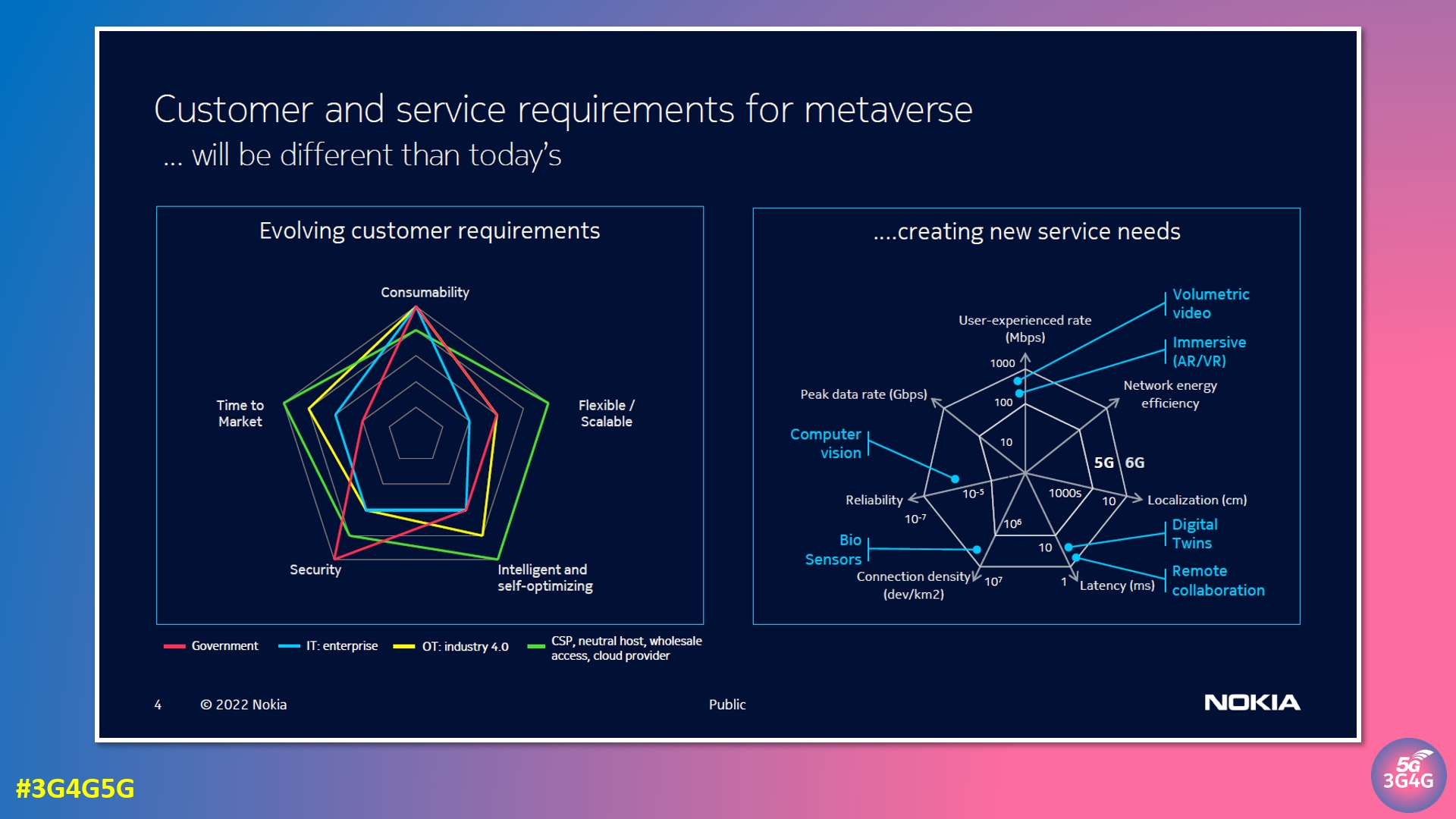
Metaverse means different things for different people. If you explain Metaverse with an example, many people understand but they are generally looking at things from a different point of view. A bit like blind men and an elephant. Similarly when we talk about Metaverse-ready networks, it can mean different things to different people, depending on their background.
Back in Oct 2021, Facebook changed its name to Meta with a vision to bring the metaverse to life and help people connect, find communities and grow businesses. This was followed by a blog post by Dan Rabinovitsj, Vice President, Meta Connectivity, highlighting the high-level requirements for these metaverse-ready networks.
At Fyuz 2022, the Telecom Infra Project (TIP) announced the launch of Metaverse-Ready Networks Project Group primary whose objective is to accelerate the development of solutions and architectures that enhance network readiness to support metaverse experiences. Meta Platforms, Microsoft, Sparkle, T-Mobile and Telefónica are the initial co-chairs of this Project Group.
A blast from the past - I'm listening to a Nokia CTO, Alessandro Bovone, setting out Nokia's view of the future #CWIC2022pic.twitter.com/DSN96eK2qh
Cambridge Wireless' CWIC 2022 discussed 'The Hyperconnected Human'. One of the sessions focussed on 'Living in the Metaverse' which I think was just brilliant. The slides are available from the event page and the video is embedded below:
Coming back to metaverse-ready networks, the final day of Fyuz 2022 conference featured 'The Meta Connectivity Summit' produced by Meta.
The main stage featured a lot of interesting panel sessions looking at metaverse use cases and applications, technology ecosystem, operator perspectives as well as a talk by CIO of Softbank. The sessions are embedded below. The breakout sessions were not shared.
Metaverse is also being used as a catch-all for use cases and applications in 6G. While many of the requirements of Metaverse will be met by 5G and beyond applications, 6G will bring in even more extreme requirements which would justify the investments in the Metaverse-Ready Networks.
In another new whitepaper on 5G-Advanced, Nokia has detailed DCCA (DC + CA) features and enhancements from Rel-15 until Rel-18. The following is an extract from the paper:
Mobility is one of the essential components of 5G-Advanced. 3GPP has already defined a set of functionalities and features that will be a part of the 5G-Advanced Release 18 package. These functionalities can be grouped into four areas: providing new levels of experience, network extension into new areas, mobile network expansion beyond connectivity, and providing operational support excellence. Mobility enhancements in Release 18 will be an important part of the ‘Experience enhancements” block of features, with the goal of reducing interruption time and improving mobility robustness.
Fig. 2 shows a high-level schematic of mobility and dual connectivity (DC)/Carrier Aggregation (CA) related mechanisms that are introduced in the different 5G legacy releases towards 5G-Advanced in Release 18. Innovations such as Conditional Handover (CHO) and dual active protocol stack (DAPS) are introduced in Release 16. More efficient operation of carrier aggregation (CA), dual connectivity (DC), and the combination of those denoted as DCCA, as well as Multi-Radio Access Technology DC (MR-DC) are introduced through Releases 16 and 17.
For harvesting the full benefits of CA/DC techniques, it is important to have an agile framework where secondary cell(s) are timely identified and configured to the UE when needed. This is of importance for non-standalone (NSA) deployments where a carrier on NR should be quickly configured and activated to take advantage of 5G. Similarly, it is of importance for standalone (SA) cases where e.g. a UE with its Primary Cell (PCell) on NR Frequency Range 1 (FR1) wants to take additional carriers, either on FR1 and/or FR2 bands, into use. Thus, there is a need to support cases where the aggregated carriers are either from the same or difference sites. The management of such additional carriers for a UE shall be highly agile in line with the user traffic and QoS demands; quickly enabling usage of additional carriers when needed and again quickly released when no longer demanded to avoid unnecessary processing at the UE and to reduce its energy consumption. This is of particular importance for users with time-varying traffic demands (aka burst traffic conditions).
In the following, we describe how such carrier management is gradually improved by introducing enhancements for cell identification, RRM measurements and reduced reporting delays from UEs. As well as innovations related to Conditional PSCell Addition and Change (CPAC) and deactivation of secondary cell groups are outlined.
The paper goes on to discuss the following scenarios in detail for DCCA enhancements:
Early measurement reporting
Secondary cell (SCell) activation time improvements
Direct SCell activation
Temporary RS (TRS)-based SCell Activation
Conditional Secondary Node (SN) addition and change for fast access
Activation of secondary cell group
The table below summarizes the DCCA features in 5G NR
In early December 2021, 3GPP reached a consensus on the scope of 5G NR Release-18. With the 3GPP Rel-17 functional freeze set for March 2022, Release-18 work is moving into focus. This is being billed as a significant milestone marking the beginning of 5G Advanced — the second wave of wireless innovations that will fulfil the 5G vision. Release 18 is expected to build on the solid foundation set by 3GPP Releases 15, 16, and 17, and it sets the longer-term evolution direction of 5G and beyond.
The 3GPP Release-18 page has a concise summary of all that you need to know, including the timeline. For anyone interested in going through features one-by-one, start navigating from here, select Rel-18 from the top.
For others who may be more interested in summary rather than a lot of details, here are some good links to navigate:
Nokia whitepaper - 5G-Advanced: Expanding 5G for the connected world (link)
Paper by Ericsson researcher, Xingqin Lin, 'An Overview of 5G Advanced Evolution in 3GPP Release 18' (link)
Marcin Dryjański, Rimedo Labs - 3GPP Rel-18: 5G-Advanced RAN Features (link)
Bevin Fletcher, FierceWireless: Next 3GPP standard tees up 5G Advanced (link)
As always, Qualcomm has a fantastic summary of 5G evolution and features in 3GPP Release-18 on their page here. The image above nicely shows the evolution of 5G from Release-15 all the way to Release-18. The image below shows a summary of 3GPP Release-18, 5G-Advanced features.
They also hosted a webinar with RCR wireless. The webinar is embedded below.
The slides can be downloaded from GSA website (account required, free to register) here.
China Mobile, along with a bunch of other organizations including China Unicom, China Telecom, CAICT, Huawei, Nokia, Ericsson, etc., produced a white paper on what technology evolutions will we see as part of 5G-Advanced. This comes not so long after the 3GPP 5G-Advanced Workshop which a blogged about here.
The abstract of the whitepaper says:
The commercialization of 5G networks is accelerating globally. From the perspective of industry development drivers, 5G communications are considered the key to personal consumption experience upgrades and digital industrial transformation. Major economies around the world require 5G to be an essential part of long-term industrial development. 5G will enter thousands of industries in terms of business, and technically, 5G needs to integrate DOICT (DT - Data Technology, OT - Operational Technology, IT - Information Technology and CT - Communication Technology) and other technologies further. Therefore, this white paper proposes that continuous research on the follow-up evolution of 5G networks—5G-Advanced is required, and full consideration of architecture evolution and function enhancement is needed.
This white paper first analyzes the network evolution architecture of 5G-Advanced and expounds on the technical development direction of 5G-Advanced from the three characteristics of Artificial Intelligence, Convergence, and Enablement. Artificial Intelligence represents network AI, including full use of machine learning, digital twins, recognition and intention network, which can enhance the capabilities of network's intelligent operation and maintenance. Convergence includes 5G and industry network convergence, home network convergence and space-air-ground network convergence, in order to realize the integration development. Enablement provides for the enhancement of 5G interactive communication and deterministic communication capabilities. It enhances existing technologies such as network slicing and positioning to better help the digital transformation of the industry.
The paper can be downloaded from China Mobile's website here or from Huawei's website here. A video of the paper launch is embedded below:
Nokia's Antti Toskala wrote a blog piece providing the first real glimpse of 5G-Advanced, here.
Back in 2019, we wrote about Release-17 study item called NR-Lite (a.k.a. NR-Light). After the study started, it was renamed as RedCap or Reduced Capability.
5G NR-RedCap (New Radio Reduced Capability Device) is now the official name of NR-Light (or NR-Lite before that). Assuming this was also being discussed in 3GPP as NR-RedCom (New Radio Reduced Complexity Device) earlier. Can anyone confirm 🤔 pic.twitter.com/WZUaJSgQ8s
We have now made a video tutorial on RedCap to not only explain what it is but also discuss some of the enhancements being discussed for 3GPP Release-18 (5G-Advanced). For anyone wanting to find out the differences between the baseline 5G devices with RedCap, without wanting to go too much in detail, can see the Tweet image for comparison.
I come across a question relating to the different type of RAN architectures once per month on an average. Even though we have covered the topic as part of some or the other tutorial, we decided to do a dedicated tutorial on this.


_April2021.jpg)